Finance leaders, auditors, and technology experts gathered at the ACCA Seminar on AI Trends in Finance & Accounting at Thang Long II Industrial Park. The discussion explored how finance teams are moving beyond tax compliance toward digital transformation and better business performance.
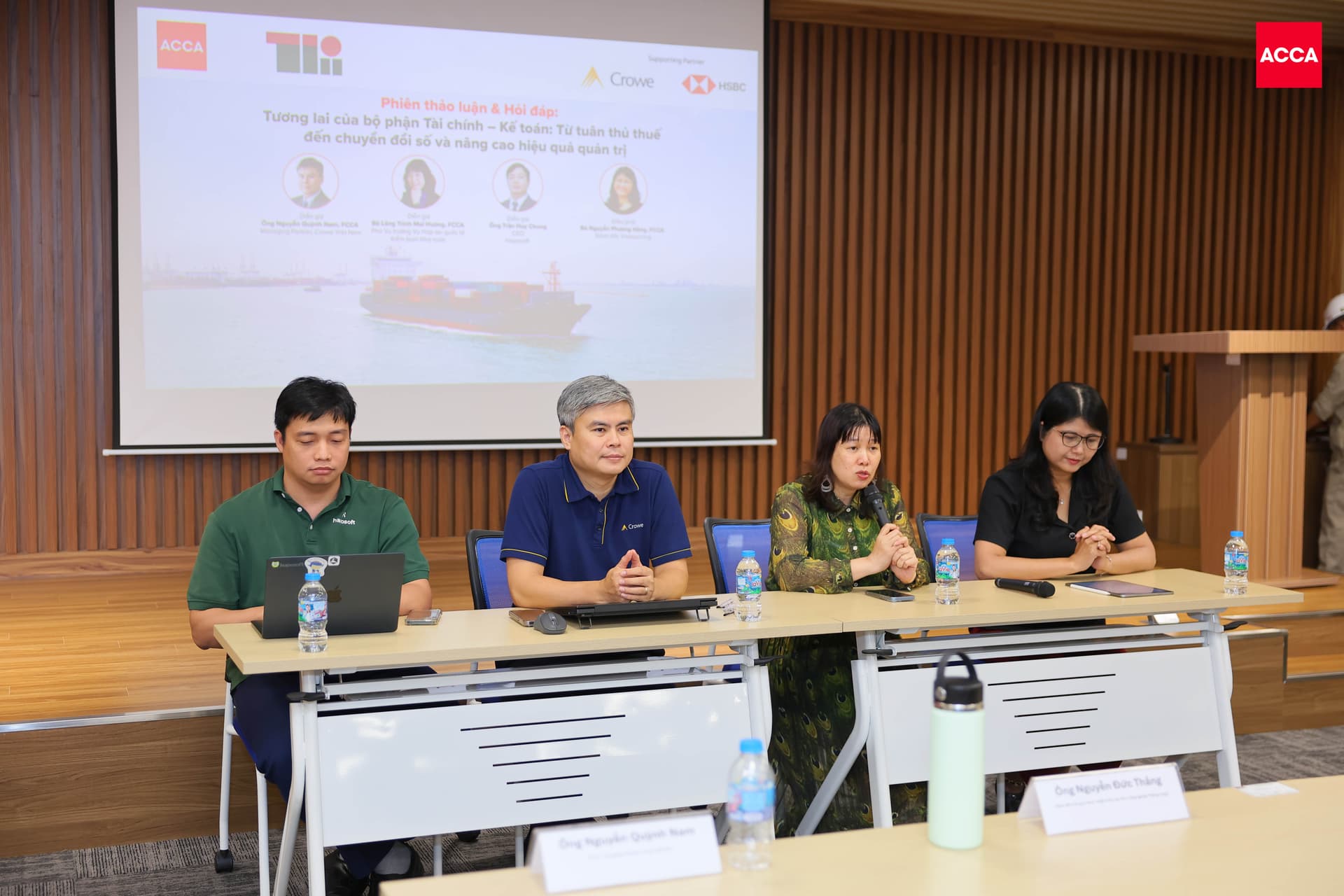
The panel featured:
- Tran Huy Chung – CEO, Haposoft
- Nguyen Quynh Nam, FCCA – Managing Partner, Crowe Vietnam
- Lang Trinh Mai Huong, FCCA – Deputy Director General, International Cooperation Department, State Audit Office of Vietnam
- Nguyen Phuong Hang, FCCA – Director, Vietsourcing (Moderator)
The discussion centered on a critical question facing finance leaders today:
How can finance teams evolve from focusing primarily on compliance to becoming strategic partners that drive business performance?
Redefining the Role of Accountants in the AI Era
For years, finance teams have spent countless hours on manual work—processing invoices, entering data, reconciling records, and validating documents. These tasks are essential, but they shouldn't consume most of an accountant's time. As AI becomes more capable, the role of finance professionals is evolving. Instead of focusing on routine transactions, they can spend more time on analysis, forecasting, risk management, and supporting business decisions. That shift is where finance creates real strategic value.
One message resonated strongly throughout the session:
AI will not replace accountants. It will empower them.
Rather than eliminating jobs, AI frees finance professionals from repetitive work, allowing them to focus on strengthening internal controls, improving governance, supporting business decisions, and creating long-term value for their organizations. The future finance function is defined not by how much data it processes, but by how effectively it transforms data into business insights.

Turning AI into Measurable Business Value for FDI Enterprises
For many FDI companies operating in Vietnam, the pressure on finance departments continues to grow. Finance leaders are expected to navigate IFRS adoption, maintain strict tax and regulatory compliance, optimize operational costs, and process an ever-increasing volume of invoices and supporting documents—all while providing faster, more accurate financial information to management. This is where AI delivers tangible business impact.
Drawing on Haposoft's implementation experience, Chung shared practical examples of how AI-powered Accounts Payable Automation and Intelligent OCR are helping enterprises modernize finance operations. By reducing manual work, improving accuracy, and identifying potential issues earlier, these solutions enable finance teams to operate more efficiently while focusing on higher-value activities. Organizations adopting these solutions have achieved measurable improvements, including:
- Reducing manual data entry time by 80–90%
- Achieving 95–99% data accuracy
- Detecting abnormal transactions earlier—before month-end closing
- Accelerating invoice processing while strengthening compliance and audit readiness
A Practical Roadmap for AI Adoption
Many organizations recognize AI's potential but struggle to turn it into practical results. One common mistake is trying to transform every finance process at once. During the seminar, Chung emphasized that successful AI adoption starts with a clear roadmap, not a large-scale rollout.
Haposoft's AI maturity model consists of four stages: Digitize → Automate → AI Assist → AI Agent.
- Digitize – Convert paper-based and fragmented processes into structured digital data.
- Automate – Eliminate repetitive workflows using intelligent automation.
- AI Assist – Enable AI copilots to support finance professionals with recommendations, analysis, and productivity.
- AI Agent – Deploy autonomous AI agents capable of executing predefined finance processes with minimal human intervention.
AI doesn't have to start with a company-wide transformation. Pick one process that matters, solve one problem well, and build from there. That's often the fastest way to show value and bring the rest of the organization along.
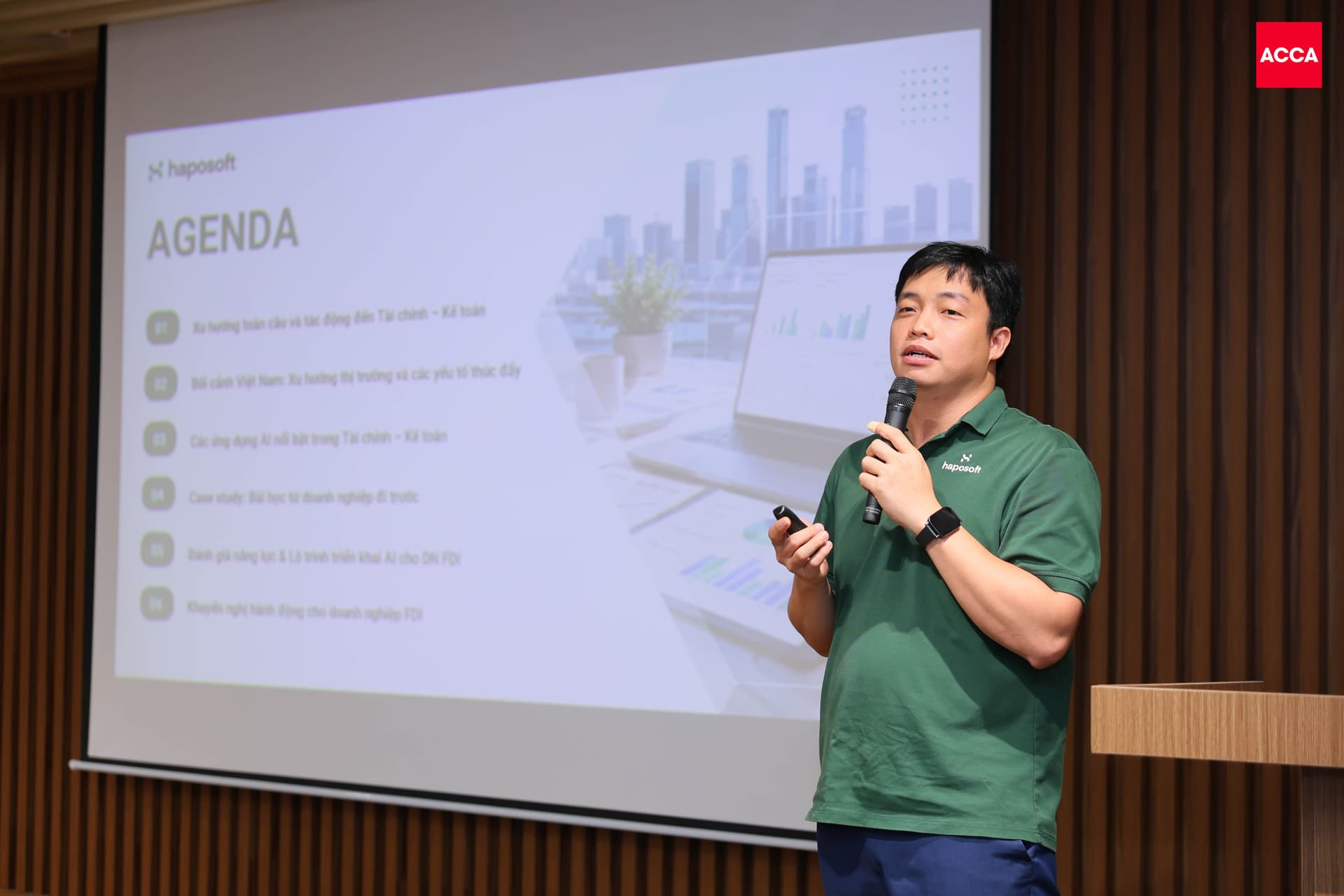
Explore the presentation here: Artificial Intelligence (AI) Adoption Trends in Finance and Accounting
A Shared Vision for the Future of Finance
The seminar brought together finance and accounting leaders from across the industry. Alongside Haposoft CEO Tran Huy Chung, the panel featured Nguyen Quynh Nam from Crowe Vietnam, Lang Trinh Mai Huong from the State Audit Office of Vietnam, and Nguyen Phuong Hang from Vietsourcing. Each speaker shared practical perspectives based on their own experience, from auditing and compliance to finance operations and digital transformation.
Although the discussions covered different topics, one message came through clearly: AI works best when it solves real business problems. For finance teams, that means spending less time on manual processes and more time on analysis, controls, and decision-making. Technology should support professionals, not replace them.
The conversations also reflected a common challenge facing many FDI enterprises today. Regulatory requirements continue to evolve, while businesses are under pressure to improve efficiency and make faster decisions. As a result, finance teams are expected to do more than ensure compliance. They are becoming key partners in driving business performance.
Looking Ahead
Every business starts its AI journey from a different place. The first priority is finding a finance process that is worth improving. Haposoft develops AI solutions for AP Automation, Intelligent OCR, and other finance applications used by FDI enterprises. Finance teams spend less time on repetitive work and gain more time for analysis, controls, and decision-making.
What is currently the biggest bottleneck in your finance process?
We'd love to hear your thoughts and continue the conversation.