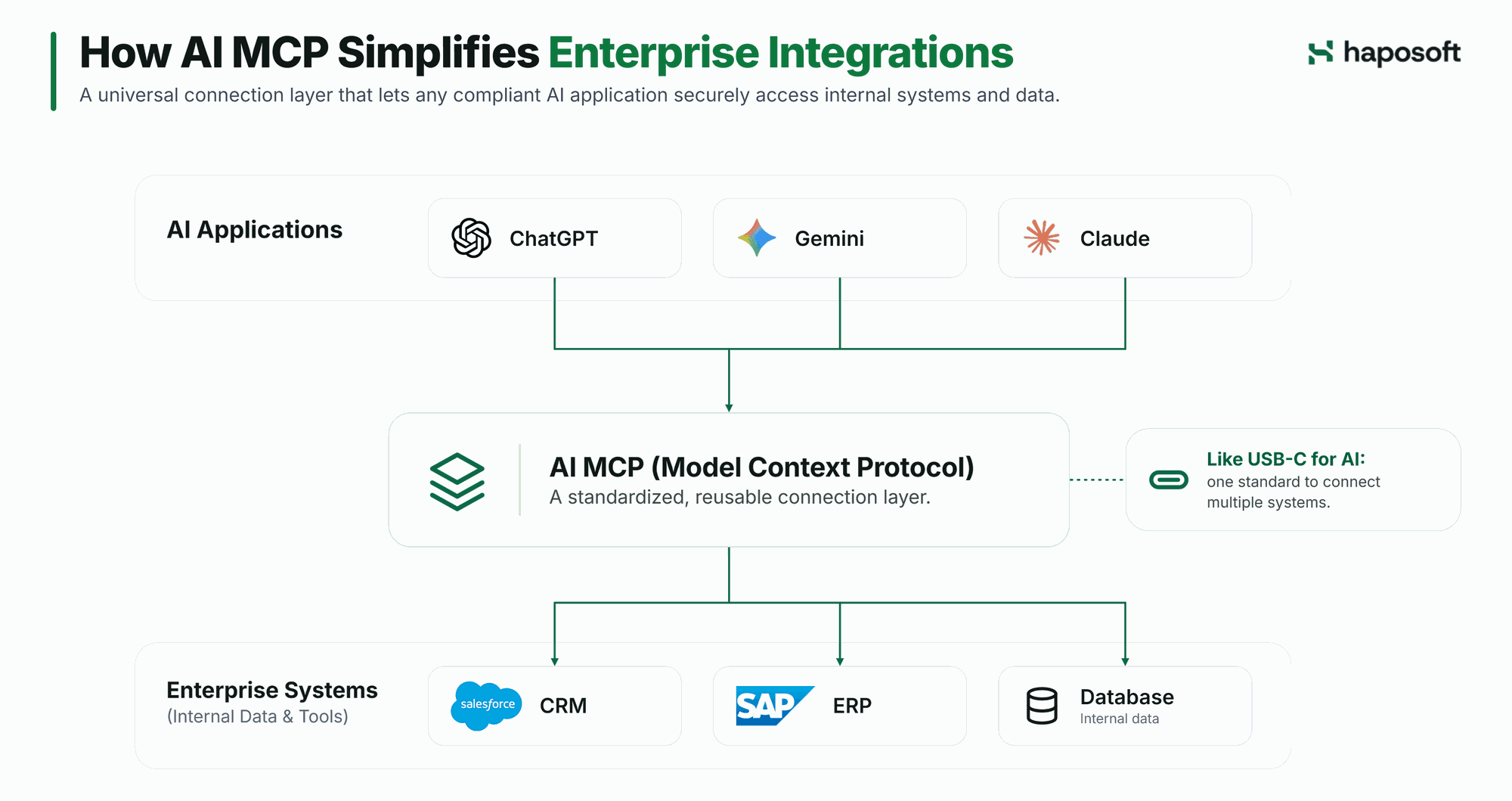
AI MCP (Model Context Protocol) is an open standard that allows enterprise AI applications to securely connect to internal company data and tools. Instead of building custom, expensive integrations for every new AI model, businesses use AI MCP to create a single, reusable connection layer.
For executive leaders, this solves a critical operational bottleneck. It helps reduce data silos and integration costs, and lowers the risk of vendor lock-in. Think of it as a USB-C port for enterprise AI: one standard connection that compliant AI systems can use to reach your CRM, ERP or databases under controlled access.
AI MCP Explained for Business Leaders
The easiest way to understand AI MCP is to start with the integration problem it solves. Historically, connecting an AI assistant to internal systems required custom coding for every single application. Every new AI tool needed its own connection to every internal system, so the number of integrations grew with each tool the company added. That approach is slow, expensive, and fragile.
The AI MCP protocol resolves this problem by introducing a universal translation layer.
For a full definition of the protocol, see What Is AI MCP? Model Context Protocol, the "USB-C" of AI. For how hosts, clients and servers fit together, see AI MCP Architecture Explained.
Consider the USB-C standard for hardware. Before USB-C, every device required a proprietary cable. Today, one cable connects a laptop, phone, and monitor. AI MCP performs the exact same function for software. A company builds one MCP server for its internal database. Any compliant AI application can then connect to it without a new custom integration.
This shift delivers three immediate business advantages:
- Cost Efficiency: Engineering teams build integrations once and reuse them across multiple AI tools.
- Operational Agility: The business can switch or add new AI models without rewriting backend code.
- Data Security: Access follows the permissions your company already manages. The AI only receives the specific data needed for each request, never direct access to entire systems.
The Business Case: Why AI MCP Is a Strategic Priority
When evaluating new technology, executive leaders must look past the technical specifications and focus on the bottom line. The core question is simple: why does MCP matter for the enterprise? The answer lies in how it fundamentally restructures the cost, risk, and scalability of AI adoption.
Eliminating the "Integration Tax"
Traditionally, connecting a new AI model to internal systems required custom engineering for every single application. If a company adopted three different AI models and needed them to access five internal tools, the engineering team had to build and maintain fifteen separate integrations. This creates a massive hidden tax on engineering resources, slowing down innovation and draining budgets.
The AI MCP protocol changes this math entirely. Developers build one standardized server for an internal tool, and every compliant AI application can reuse it without a new custom integration. This "build once, connect anywhere" model can significantly reduce initial development hours and long-term maintenance overhead, freeing up technical teams to focus on core business logic rather than repetitive plumbing.
Future-Proofing Against Vendor Lock-in
The enterprise AI market is highly volatile. A model that leads the industry today might be outperformed or priced out tomorrow. Relying on proprietary, closed integration methods locks a company into a specific vendor ecosystem, making it incredibly costly to pivot.
MCP acts as a strategic insurance policy. Because the protocol is open and standardized, it creates a clean abstraction layer between the AI model and the company's data. A business can swap out the underlying AI provider without touching the backend data integrations. The company retains full control over its AI strategy and can adopt better, more cost-effective models as they emerge without rewriting core infrastructure.
Enabling Scalable Enterprise AI
Many organizations start with a simple, isolated internal chatbot. As the use case proves successful, leadership naturally wants to expand AI capabilities across HR, finance, and customer support.
Without a standard like MCP, scaling this initiative creates a tangled web of custom code, fragile dependencies, and compounding security risks. MCP provides the foundational architecture required to scale safely. It allows IT teams to deploy secure, standardized AI agents across the entire organization, knowing that the underlying data connections are robust, auditable, and built for enterprise-grade workloads.
Enterprise Security and Data Governance
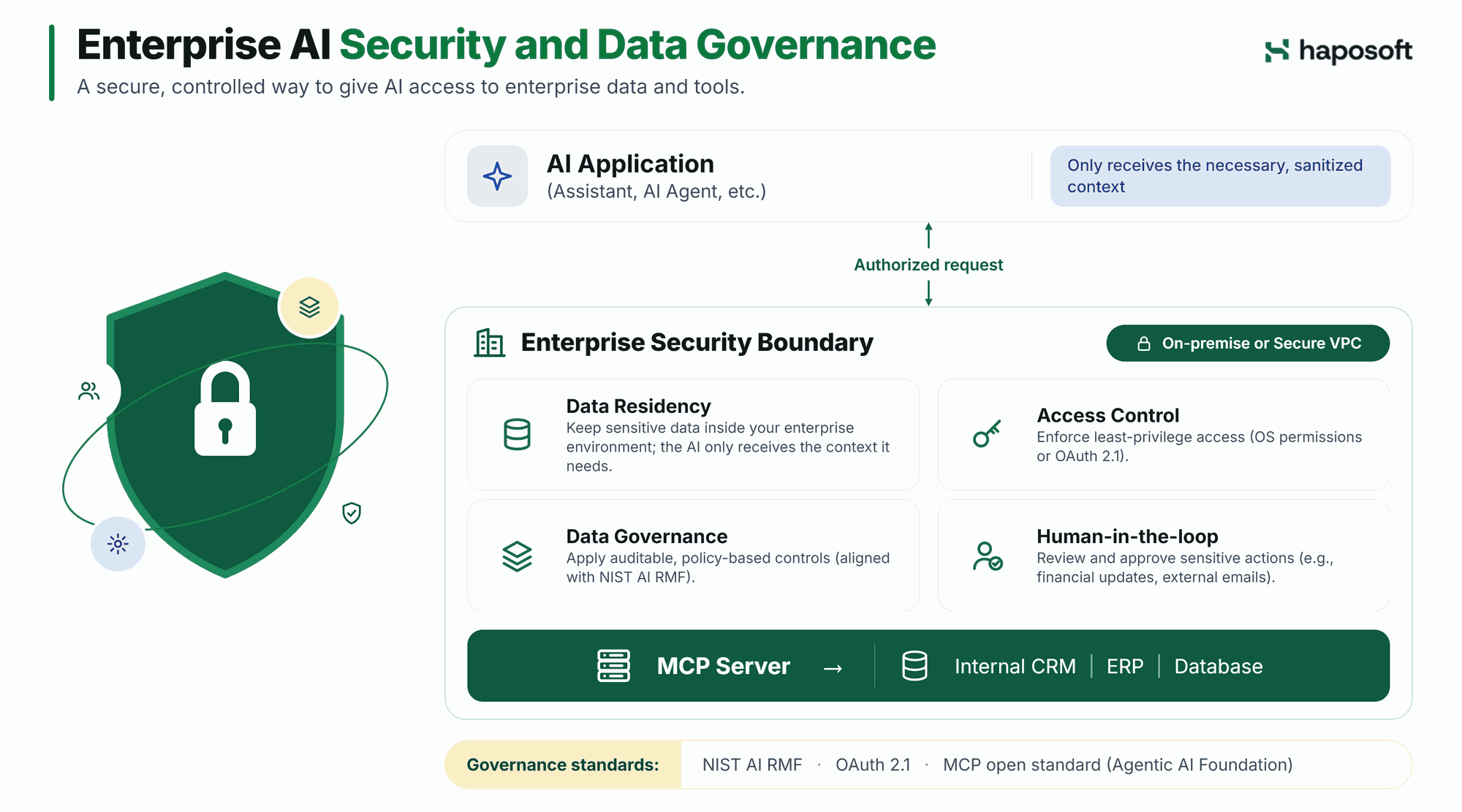
For Chief Information Security Officers and IT directors, adopting any new AI protocol immediately triggers red flags around data exposure. The traditional model of sending proprietary CRM records or financial data to an external AI cloud provider introduces unacceptable risk. The AI MCP protocol reduces this risk by keeping the data exactly where it belongs and controlling precisely what the AI can see. Since December 2025, the protocol has also been governed by the Agentic AI Foundation under the Linux Foundation, so its direction is open and auditable rather than controlled by a single vendor.
Instead of pushing sensitive information out to an external vendor, the AI connects to the data where it already lives. For sensitive data, the MCP server can run on your internal infrastructure or within your secure Virtual Private Cloud. With this compute-to-data approach, your databases are never copied or handed over to an AI vendor, and the AI model only receives the specific, sanitized context it needs to answer a query. If you use a cloud-hosted AI model, that context does leave your network for each request, so choose a provider with enterprise data terms (no training on your data, clear retention limits) or run a self-hosted model for the most sensitive workloads.
This localized execution model is backed by concrete security mechanisms rather than theoretical promises. For local deployments, MCP servers run with the existing operating system permissions of the user who launched them, so they can only reach what that user can already access. For remote or third-party integrations, the specification defines a standard authorization flow based on OAuth 2.1, as detailed in the official MCP security specifications, ensuring that access tokens are managed securely and can be revoked at any time.
Beyond passive data retrieval, MCP supports strict governance over active operations through a human-in-the-loop design. The MCP specification recommends that a person can always review and deny an AI action, and enterprise AI applications put this into practice: when the AI needs to execute a sensitive action, such as modifying a financial record or sending an external email, the user must explicitly approve it before the action is finalized. The system presents the proposed action to the user for review, effectively putting a manager in the loop for every critical AI decision and giving compliance teams full visibility.
Government guidance points in the same direction. In May 2026, CISA, the NSA and the national cyber security agencies of Australia, Canada, New Zealand and the United Kingdom jointly published Careful Adoption of Agentic AI Services. It advises organizations to give AI agents only the access each task requires, keep humans in the loop for high-impact actions, and monitor agent activity continuously.
For companies operating across different regions, several regulatory frameworks are relevant:
- European Union: The EU AI Act adds legal obligations for companies serving Europe. Under the AI Omnibus published in July 2026, the rules for high-risk AI systems listed in Annex III now apply from December 2, 2027.
- Japan: Japan's AI Guidelines for Business were updated to version 1.2 in March 2026 and now include a definition of AI agents.
- Vietnam: Vietnam's Law on Artificial Intelligence (No. 134/2025/QH15) took effect on March 1, 2026 with a risk-based classification of AI systems (Rajah & Tann Asia).
MCP fits these expectations well: each server is a clearly defined, auditable access point with its own permissions, rather than a hidden custom integration.
High-Impact Enterprise Use Cases
Theoretical benefits of AI MCP are compelling, but real-world application is what ultimately drives executive buy-in. Organizations achieve the highest return on investment when they apply this protocol to high-friction, data-heavy workflows. The following use cases demonstrate how MCP transforms isolated systems into cohesive, intelligent operations.
Connecting Haposoft's Own Business Systems
Haposoft has built MCP servers for its own products: Hapo ERP (an ERP for fastener manufacturers), Hapo SMS and Hapo OKR. Each system has its own MCP server, and one AI application, Claude, connects to all of them. Staff can check production orders and inventory, review the sales pipeline and payment status, or submit OKR check-ins from a single chat window. The servers run remotely, each user signs in with OAuth, and access follows that user's own permissions. The servers expose no tools for deleting or approving records, and any change to data requires the user's confirmation.
Unified Customer Support Operations
Customer service teams often waste valuable time switching between multiple disconnected platforms to resolve a single support ticket. An MCP-enabled AI assistant can securely connect to Zendesk for ticket history, Jira for engineering bug status, and the internal knowledge base simultaneously. With this combined context, the AI can draft accurate, complete responses in seconds for an agent to review. Teams can expect shorter resolution times and, over time, better customer satisfaction scores.
Automated Financial Reporting
Generating monthly financial reports traditionally requires analysts to manually extract data from legacy ERP systems and format it in complex spreadsheets. With an MCP server connected directly to the internal SQL database, an AI agent can retrieve real-time revenue figures and expense breakdowns on demand. This approach reduces manual data entry errors and can shorten the reporting cycle from days to hours. Leadership gains immediate, accurate insights for strategic decision-making without overburdening the finance team.
Intelligent HR and Employee Onboarding
New employees frequently ask repetitive questions about company policies, benefits, and IT setup, which steadily drains HR resources. An MCP-integrated HR assistant can query Workday for specific employee details and cross-reference internal policy wikis to provide precise, personalized answers. This automation frees up the HR team to focus on strategic talent initiatives. At the same time, it ensures new hires receive immediate, accurate support, improving their overall onboarding experience.
Strategic Roadmap: How to Adopt AI MCP in Your Enterprise
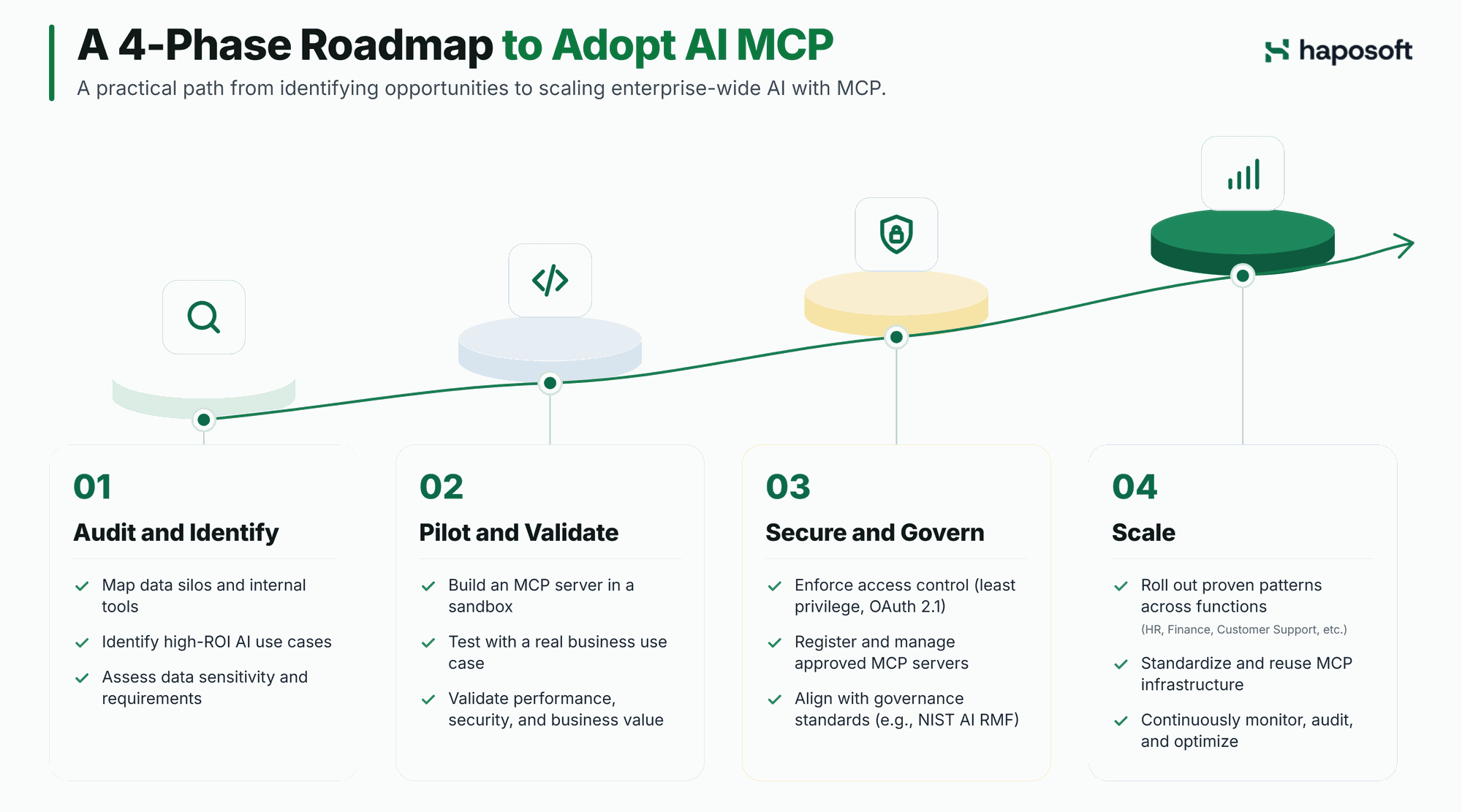
Adopting a new enterprise standard requires a disciplined approach to avoid disrupting critical business operations. Rushing into a comprehensive deployment without a clear strategy often leads to security vulnerabilities and wasted engineering resources. A phased rollout allows leadership to validate the technology, establish governance, and measure return on investment before committing to a transformation across the entire organization.
Phase 1: Audit and Identify
The first step involves mapping your current application portfolio to identify highly valuable integration opportunities. IT leaders must pinpoint existing data silos where fragmented information slows down decision making or frustrates employees. Prioritizing use cases with clear and measurable return on investment ensures the initial investment delivers immediate business value and builds internal momentum for the broader initiative.
Phase 2: Pilot and Validate
Once priority targets are identified, organizations should launch a controlled pilot program with a lower-risk internal system, for example through an initial AI implementation. This sandbox environment allows engineering teams to test the MCP server performance, evaluate the quality of AI responses, and identify any hidden technical dependencies. Successfully validating a single use case provides the empirical data needed to secure executive approval for larger and more complex deployments.
Phase 3: Secure and Govern
Security and compliance must be formalized before expanding the pilot to sensitive business data. This phase involves establishing strict access controls, defining which AI tools are permitted to execute specific actions, and creating an internal registry of approved MCP servers. Aligning these technical controls with established frameworks like the NIST AI Risk Management Framework ensures the AI initiative remains fully compliant with industry regulations and internal policies.
Phase 4: Scale
With a secure foundation and proven pilot results, the organization can begin scaling the MCP architecture across all departments. IT teams can rapidly deploy standardized AI agents to HR, finance, and customer support, leveraging the reusable connection layer built during the pilot. This systematic expansion transforms isolated AI experiments into a cohesive enterprise intelligence network that drives sustained operational efficiency.
FAQ: Addressing Executive Concerns
Is AI MCP secure for enterprise data?
Yes, when deployed correctly. MCP uses a compute-to-data architecture where the server can run inside your secure VPC or on-premise infrastructure, so the AI only receives the specific data each request needs instead of direct access to your systems. Access follows your existing identity management policies, and sensitive actions can require human approval.
Does adopting MCP lock us into a specific AI vendor?
No. MCP is an open, vendor-neutral standard that separates your data integrations from the AI model. You can switch AI providers or move to newer models without rebuilding your data integrations, as long as the new AI application supports MCP.
What is the expected ROI timeline for AI MCP adoption?
Many organizations can launch a first MCP pilot within weeks, because they reuse existing systems instead of building custom integrations from scratch. The full return depends on the use case, but savings grow with every additional AI tool that reuses the same MCP servers.
How does MCP differ from traditional API integrations?
Traditional API integrations need custom code for every pair of AI tool and system. MCP gives each system one standard interface that any compliant AI application can reuse. This addresses the N×M integration problem and can significantly reduce long-term maintenance work.
Do we need to rebuild our existing systems to use MCP?
Usually not. MCP servers act as lightweight bridges to your existing databases and applications, so the underlying systems rarely need changes. Your current infrastructure stays in place while gaining secure, standardized AI connectivity.
Conclusion
Most enterprise AI pilots face challenges when connecting to internal systems, as custom integrations for each tool can be costly to build and maintain. Managing different APIs, authentication methods, and data access rules also adds complexity as integrations expand. Haposoft helps simplify this process by deploying standardized MCP servers that connect existing databases and SaaS applications to AI models. Contact Haposoft to discuss your use cases and MCP integration requirements, or learn how our AI First Win service can help you get started.