AI MCP, short for Model Context Protocol, is an open standard that lets AI applications such as Claude connect to external data sources and tools through a common interface. Introduced by Anthropic in November 2024, MCP replaces one-off integrations with reusable MCP servers, making it easier for AI systems to reach the information and capabilities they need.
MCP is most useful when several AI applications or agents need to work with the same systems. For a single application connecting to one API, a direct integration may be simpler.
What Does MCP Stand for in AI?
MCP stands for Model Context Protocol. Each word describes one part of the problem it solves:
- Model: the AI system making the request — an LLM such as GPT, Claude or Gemini, or an agent built on top of one.
- Context: the information the model needs to answer well, such as database records, local files, internal API responses and messages from tools like Slack.
- Protocol: the agreed format for exchanging that information. Instead of writing a separate integration for every AI model and every data source, developers follow one specification.
Why Is MCP Called the "USB-C" of AI?
MCP is often described as a "USB-C port for AI applications". The analogy fits: before USB-C, every device shipped with its own proprietary cable, and moving data between gadgets meant juggling incompatible connectors. MCP performs the same unifying role for AI, giving any compliant host a standardized way to access contextual data from any source without redundant coding.
AI integration had the same problem. Connecting an assistant to PostgreSQL meant custom code; connecting it to Slack meant a different implementation; reading a local folder meant yet another. With MCP, a team builds one MCP server for a data source, and any AI client that supports the protocol can use it. Switching from Claude Desktop to another MCP-compatible host, such as an IDE or an in-house agent, does not require rewriting that server.
How Does AI MCP Work?
MCP is built on JSON-RPC 2.0 and supports two transports: stdio for local servers and Streamable HTTP for remote servers (which replaced the earlier HTTP+SSE transport in the March 2025 specification). The same server code with minor changes can run locally during development and be deployed to a remote endpoint in production.
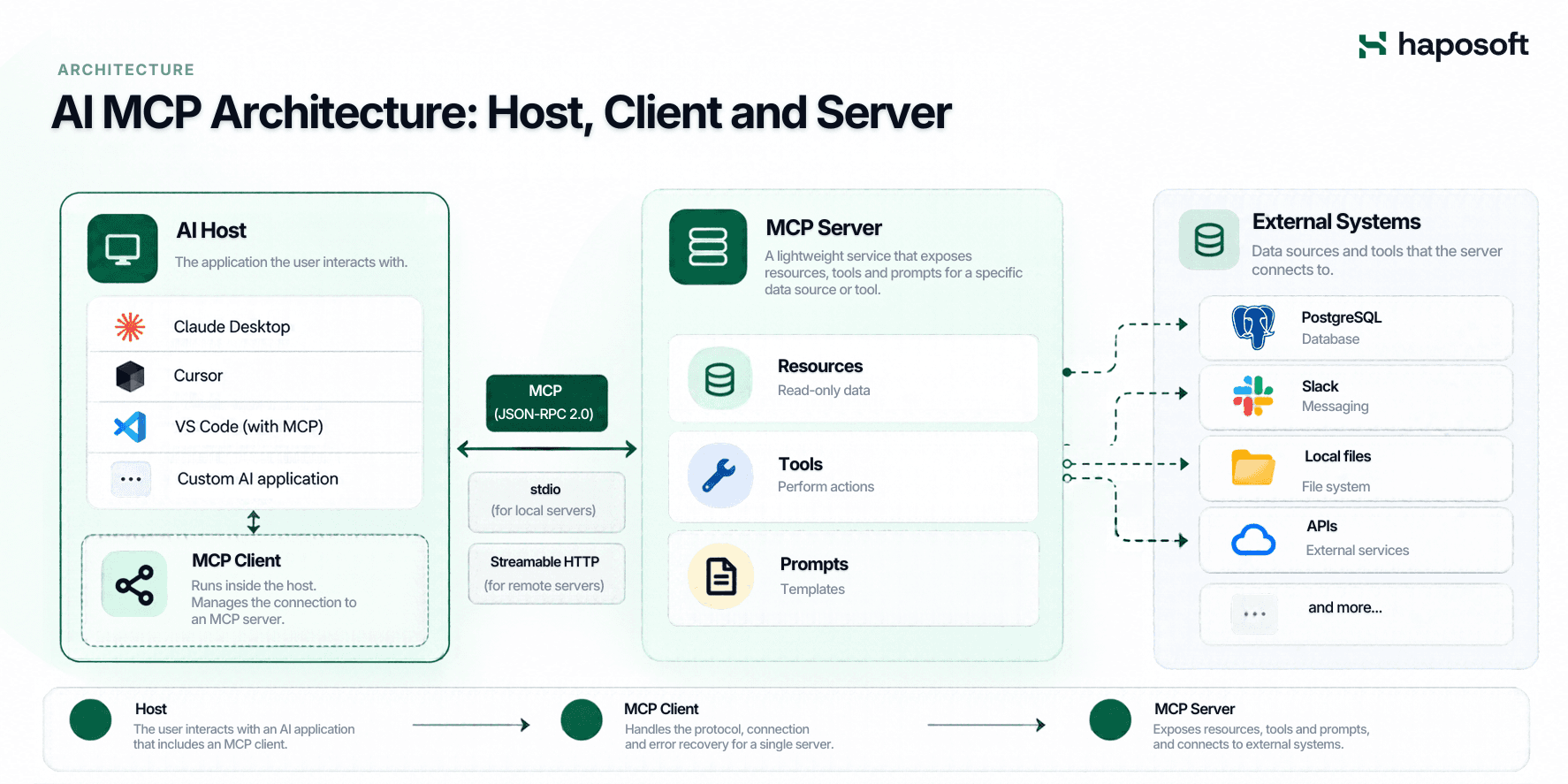
AI MCP Architecture: Host, Client and Server
- MCP host: the application the user interacts with, such as Claude Desktop, an IDE like Cursor, or a custom enterprise AI agent. The host embeds one or more MCP clients and manages their lifecycle.
- MCP client: a communication layer inside the host. Each client keeps a connection with exactly one MCP server and handles message framing, capability negotiation and error recovery.
- MCP server: a lightweight service that exposes a specific data source or tool. During the initialization handshake, the server declares which capabilities it supports, such as tools, resources, and prompts. The client then retrieves the actual lists of available tools, resources, and prompts through the corresponding methods (tools/list, resources/list, and prompts/list).
The Three MCP Primitives
- Resources: read-only data selected by the host/application for the AI to access on demand, such as file contents, database rows, API responses or log entries. Resources have URIs and can be subscribed to for change notifications.
- Tools: functions the AI can invoke to perform actions, such as sending a Slack message, creating a GitHub issue or running a SQL query. Tools have structured input schemas and return structured output.
- Prompts: pre-built templates that help users work with a server, such as a "code review" prompt that pulls in a specific pull request.
How a Request Flows Through MCP
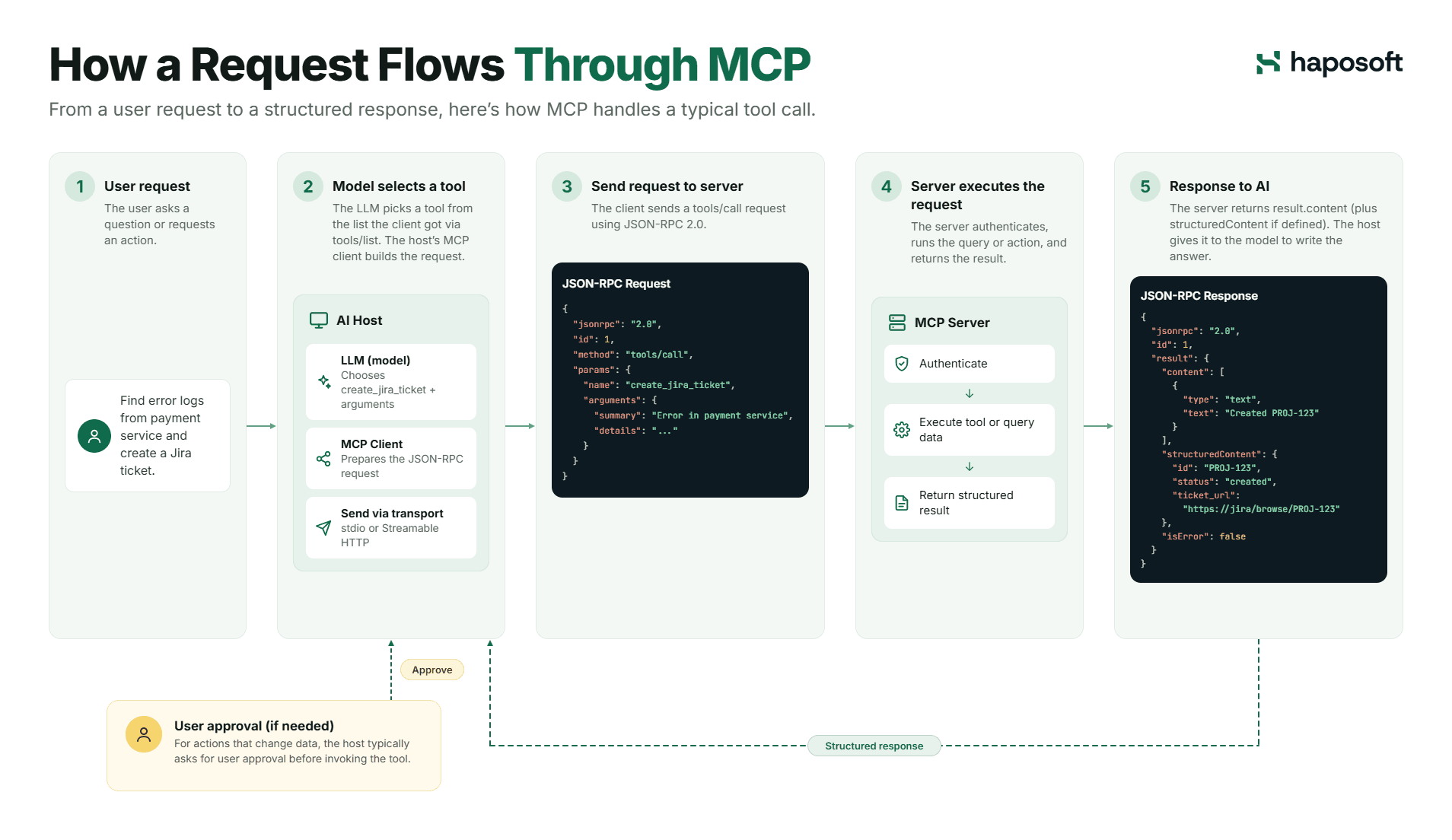
When a user's request needs external information, the host gives the model the list of available tools, and the model decides which tool to call. The host can also attach resources as context. The MCP client sends the request to the server as a JSON-RPC message. The server authenticates against the underlying service, runs the query or action, and returns the result as structured JSON.
For actions that change data, the host typically asks the user to approve the tool call first. The MCP specification asks hosts to obtain user consent before invoking tools; how strictly this is enforced depends on the host application.
Capability Negotiation
When a client connects to a server, both sides exchange protocol versions and declared capabilities. This handshake prevents a client from calling a tool the server does not implement, or using a feature, such as resource subscriptions, that the other side does not support.
Security Model and Risks
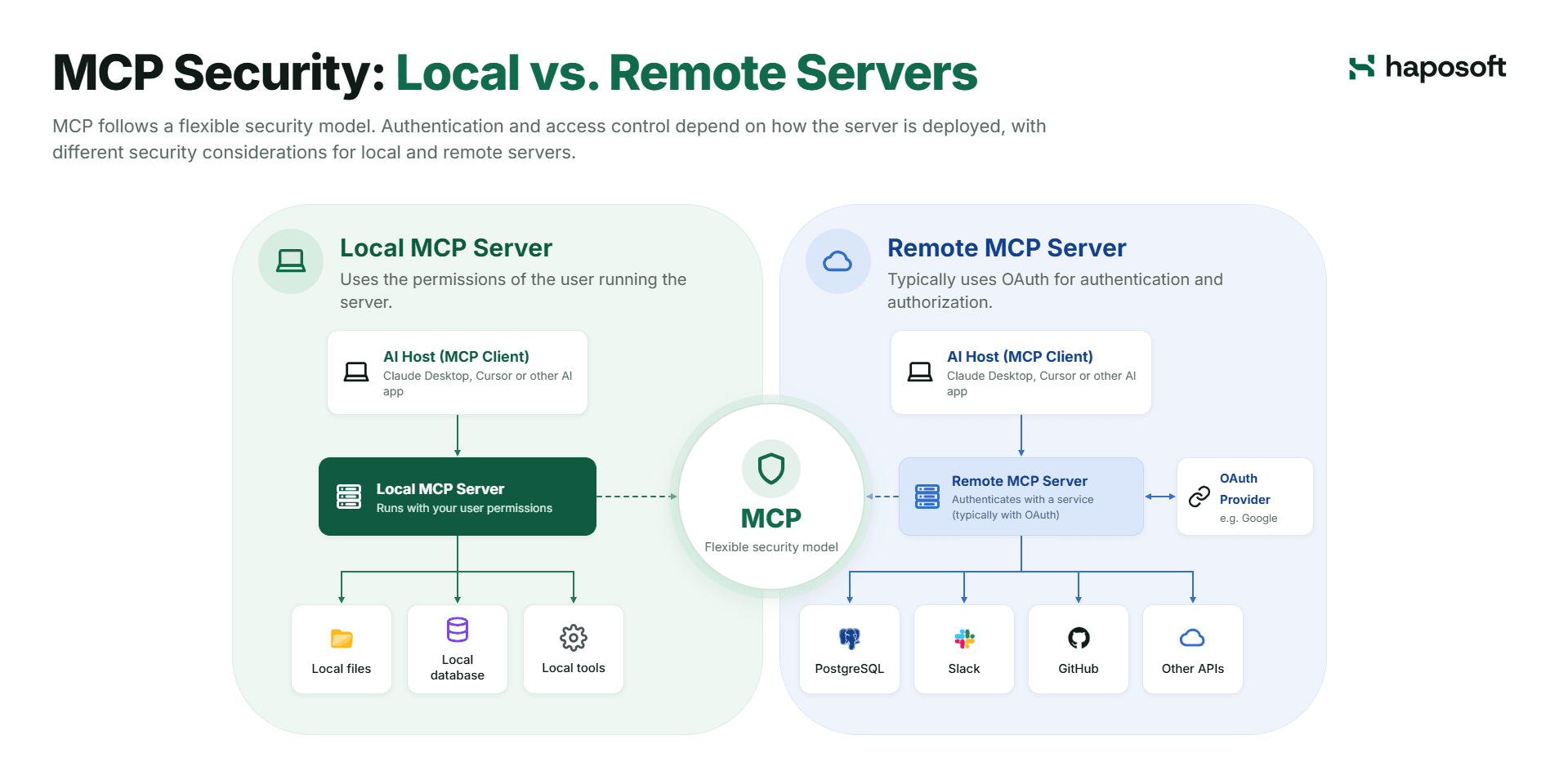
Local MCP servers run with the launching user's permissions, while remote servers typically use OAuth. This introduces trade-offs: tool results can carry prompt injections, and unreviewed third-party servers may over-expose data. Mitigate these risks by reviewing and pinning third-party servers, enforcing least-privilege accounts, requiring user approval for state-changing actions, and logging tool calls for audit.
Why AI MCP Matters for Enterprise AI
MCP changes how organizations connect AI to their systems in three ways.
For Developers: Build Once, Use Everywhere
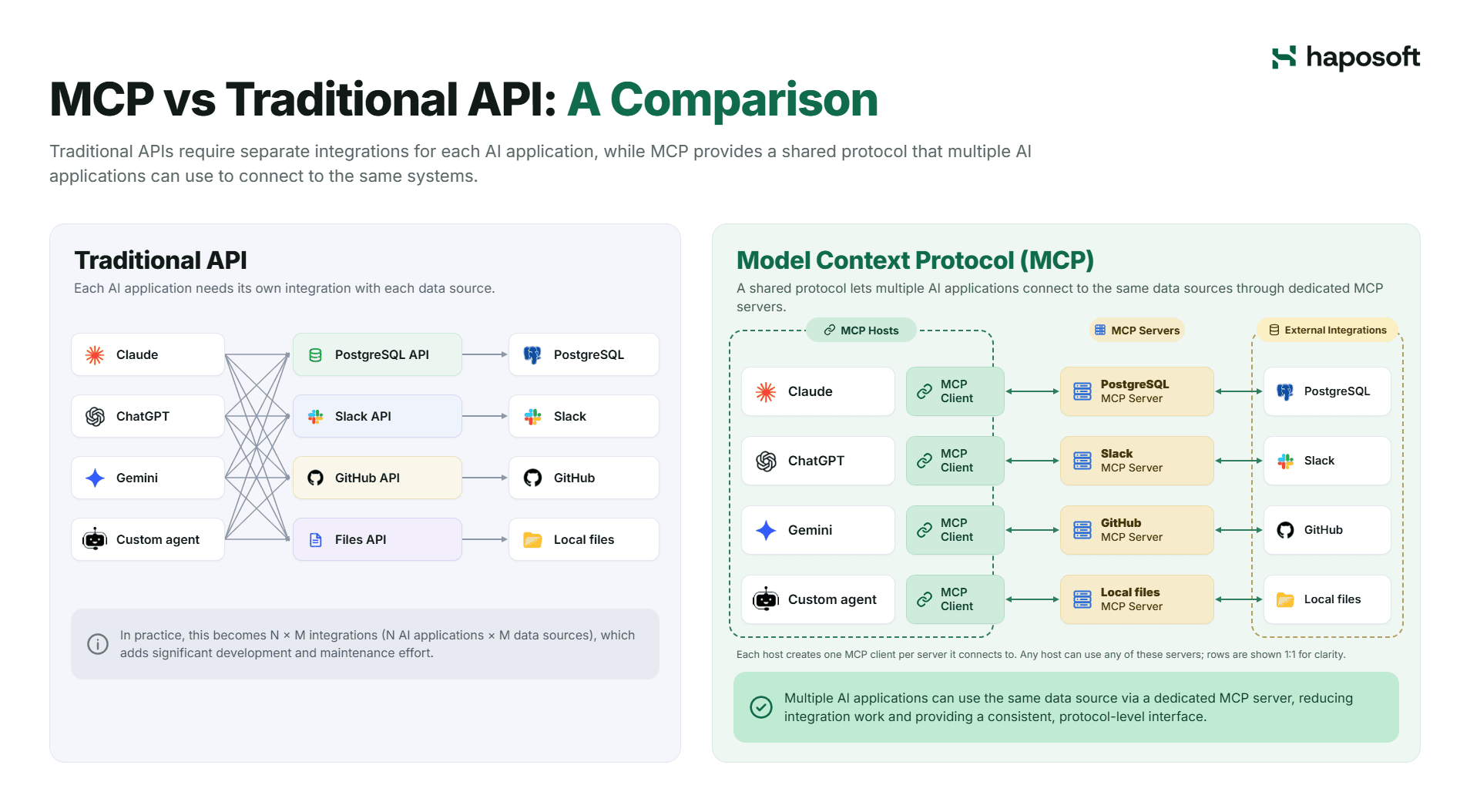
Without MCP, a team supporting several models — for example Claude, an internal open-source model and a legacy system — maintains separate integration code for the same data source. MCP decouples the data layer from the model layer: developers write one MCP server, and any compliant AI host can connect to it. This reduces duplicated integration work when several AI hosts share the same data source.
For Enterprises: Keep Data Where It Lives
Sending CRM records, financial data or internal codebases to a third-party AI provider raises security and compliance concerns. With MCP, the AI connects to data where it already lives: the MCP server can run on-premise or inside the company's Virtual Private Cloud (VPC) and enforce existing identity and access management (IAM) policies, so access to data remains controlled by existing IAM policies, regardless of where the model runs.
For AI Agents: From Answers to Actions
A language model is only as useful as the actions it can take. By exposing tools and resources in one standard way, MCP lets agents run multi-step workflows: read a local error log, query a PostgreSQL database for related user records, then draft a Jira ticket — without custom glue code for each step.
MCP vs Traditional API: A Comparison
|
Criteria |
Traditional API integration |
AI MCP (Model Context Protocol) |
|---|---|---|
|
Nature |
Point-to-point, custom-built for each AI model and data source pair |
Open standard with one specification for all compliant hosts and servers |
|
Scalability |
Adding a new AI model means new integration code |
One MCP server works with any compliant AI host |
|
Context handling |
APIs return raw data (JSON, XML) the AI must interpret |
Servers provide structured context, tool definitions and prompt templates for AI |
|
Security model |
API keys and tokens managed per integration |
Depends on deployment: local servers inherit user permissions; remote servers use OAuth; third-party servers need review |
|
Maintenance |
Each integration changes when the model or the data source changes |
Data-source changes only touch the MCP server |
|
Discovery |
Developers read API docs to find endpoints |
Clients query available tools and resources at runtime |
Traditional API integration treats AI as one more consumer of data, leaving developers to bridge raw responses and what the model needs. MCP adds protocol-level support for how AI systems discover and use data and tools.
When Is MCP the Right Choice?
MCP pays off when several AI applications or agents need the same data sources and tools. For a single model calling one or two stable APIs, direct API integration or native function calling is usually simpler to ship and debug.
|
Situation |
Better fit |
Why |
|---|---|---|
|
Several AI hosts need the same CRM, database or file system |
MCP |
One server serves every compliant host |
|
An agent chains actions across many systems |
MCP |
Tools are discovered at runtime with structured schemas |
|
One model, one or two stable APIs, fixed workflow |
Direct API or function calling |
An MCP server adds a process and protocol layer with little reuse |
|
Large document collections searched semantically |
RAG (optionally exposed through an MCP server) |
MCP standardizes access but does not index or rank content |
|
High-volume backend pipelines with no AI host in the loop |
Direct API |
No model is choosing tools, so the extra layer adds no value |
FAQ: Common Questions About AI MCP
What is AI MCP in simple terms?
AI MCP (Model Context Protocol) is an open standard that lets AI applications connect to external data sources and tools through one common interface, instead of a custom integration for every model and data source.
What are AI MCP servers, tools and connectors?
An MCP server is a lightweight program that exposes a data source, such as a PostgreSQL database or a local file system, to AI. An MCP tool is a function the AI can trigger through the server, such as send_slack_message or run_sql_query. "Connector" is commonly used for the integration that links an MCP server, or an AI app, to a third-party service.
How do AI agents use MCP?
AI agents use MCP to discover and execute actions dynamically. Instead of relying on hardcoded logic, the agent queries the MCP server for available tools, formats a structured request, and sends it. The server executes the action (often after user approval) and returns the result as structured context for the AI's next reasoning step.
Which AI platforms support MCP?
As of October 2026, MCP is natively supported in Claude Desktop, Cursor, VS Code, and Windsurf. Since 2025, OpenAI, Google, and Microsoft now offer MCP integration in products such as ChatGPT, Gemini CLI, GitHub Copilot, and Microsoft Copilot Studio. Major AI agent frameworks like LangChain and CrewAI have integrated the protocol.
Why do we need MCP in AI?
MCP reduces data silos and repeated integration work. Teams build one MCP server per data source, and any compliant AI host can use it instead of a new integration for every model.
Are MCP servers AI agents?
No. An MCP server is a passive data provider or tool executor with no reasoning of its own. The AI agent in the host reasons, plans and decides when to call the server's tools.
Do all AI agents use MCP?
Not yet. Adoption is growing across major AI platforms and agent frameworks, but many agents still rely on custom API wrappers or proprietary plugins.
Conclusion
Model Context Protocol has moved quickly from a new specification to shared infrastructure for AI applications. Popular AI assistants and IDEs now support it, and many teams are building agent strategies around it. For teams evaluating MCP, the practical question is which data sources to connect first, and which ones are better served by a direct API.
Haposoft has also developed MCP servers for its products, including Fastener ERP, Hapo SMS and Hapo OKR. Through Claude, users can check production orders and inventory, review sales pipelines, contracts and payment status, and submit OKR check-ins without accessing each system separately. Access is limited by the permissions of the signed-in user, and any changes to data require confirmation.
Getting started:
- Read the official Model Context Protocol documentation to understand the core specification.
- Explore community-built MCP servers on GitHub (for example, PostgreSQL, Slack or local file systems), and review each one before use.
- Planning MCP for your systems? Talk to Haposoft's AI MCP team about secure, on-premise MCP integrations for your AI agents.