On June 11, 2026, the Ministry of Industry and Trade issued Circular 31/2026/TT-BCT regulating the traceability of products and goods under the Ministry's management. The Circular takes effect from July 1, 2026, and establishes a mandatory roadmap for identifying and tracing the origin of high-risk product groups.
This move also marks a significant change after Circular 11/2026/TT-BCT on food traceability was temporarily suspended before its implementation. Instead of focusing solely on food, the scope of Circular 31 has been expanded to include many product and commodity groups under the management of the Ministry of Industry and Trade.
However, not all businesses are subject to this requirement.
Currently, most businesses are concerned with three questions:
- Does my business fall under the requirements for implementing product traceability as stipulated in Circular 31?
- When should the identification and traceability process be completed?
- What data, systems, and processes need to be prepared to meet the new requirements?
In this article, we will analyze the scope of application of Circular 31/2026/TT-BCT, the industry groups that need special attention, the implementation roadmap, and what businesses should prepare now to avoid being caught off guard when the regulations officially come into effect.
Does your business qualify for this requirement?
This is the most important question when assessing the impact of Circular 31/2026/TT-BCT.
A common misconception is that all businesses producing food or consumer goods must implement traceability under the new regulations. In reality, the mandatory obligation only arises when a business simultaneously meets two conditions.
Condition 1: The product falls under the management of the Ministry of Industry and Trade.
For food products, the scope of management is defined by Decree 15/2018/ND-CP. Some product groups under the management of the Ministry of Industry and Trade include:
- Soft drinks;
- Processed milk;
- Cakes, jams, candies;
- Vegetable oil;
- Flour, starch;
- Beer, wine, and alcoholic beverages.
Conversely, meat and meat products fall under the purview of other specialized management agencies and are therefore not automatically subject to Circular 31.
Condition 2: The product belongs to the high-risk goods category.
Circular 31 does not directly list high-risk products and goods.
According to current regulations, this list will be issued separately by the Ministry of Industry and Trade based on an assessment of the risk level of each product group. Therefore, whether a business is subject to mandatory requirements needs to be further compared with the official list when it is published.
According to currently available information, several categories such as soft drinks, non-alcoholic beverages, processed milk, and dairy products are considered to be at high risk of being subject to mandatory traceability implementation.
Quick conclusion
Businesses are only required to comply with Circular 31 when:
- This product falls under the purview of the Ministry of Industry and Trade.
- This product is classified as a high-risk commodity by the Ministry of Industry and Trade.
These are the sectors that should start preparing now.
Although the official list of high-risk goods is still being finalized, current public information suggests that several industry groups are highly likely to be directly impacted by Circular 31. For businesses in these groups, preparing data and systems early will significantly reduce pressure when entering the mandatory implementation phase.
High priority group
Soft drinks
Beverages are a product group under the management of the Ministry of Industry and Trade and are frequently mentioned in documents related to the classification of high-risk goods. Businesses that manufacture or trade products such as:
- Soft drink
- Bottled tea
- Energy drinks
- Ready-made drinks
- Drinks with jelly
- Drinks containing aloe vera
Therefore, it is advisable to proactively prepare for scenarios where mandatory traceability is required.
Processed milk and dairy products
This group is considered highly likely to be eligible. It includes:
- Liquid milk
- Fermented milk
- Powdered milk
- Condensed milk
- Cheese
- Butter
- Dairy products
Due to the specifics of managing production batches, expiration dates, and the cold chain, businesses in the dairy industry often need more time to standardize traceability data.
Cream and frozen dairy products
Ice cream products containing milk or classified as processed dairy products should be evaluated within the same category as the dairy industry. Businesses need to review their SKU catalog and product declaration documents to accurately determine the scope of application.
The team needs to continue monitoring.
Confectionery
Confectionery falls under the purview of the Ministry of Industry and Trade. However, at present, there is insufficient evidence to confirm that the entire confectionery category will be classified as high-risk goods. Businesses should monitor the official list before drawing any final conclusions.
Jelly and jelly cups
Edible jelly products are generally classified under the category of cakes, jams, and candies. Unlike beverages containing jelly, this category has not yet been clearly identified as high-risk goods. Therefore, businesses should continue to monitor further guidance documents from the Ministry of Industry and Trade.
This group is generally not within the scope of Circular 31.
Meat and meat products
According to current regulations, meat and meat products fall under the purview of other specialized management sectors and are not classified as food products under the Ministry of Industry and Trade. Therefore, most conventional meat processing businesses will not be subject to the mandatory requirements of Circular 31.
However, businesses must still meet traceability and food safety requirements as stipulated by the relevant industry regulations.
|
Product group |
Preparation priority level |
|
Soft drinks |
Very high |
|
Drinks with jelly |
Very high |
|
Processed milk |
Very high |
|
Dairy products |
Very high |
|
Cream |
High |
|
Confectionery |
Monitor |
|
Jelly |
Monitor |
|
Processed meat |
Usually not within the scope of Circular 31. |
Key points to note regarding the implementation roadmap of Circular 31 for businesses.
One of the most important aspects of Circular 31 is the provision of a phased implementation roadmap, rather than requiring businesses to fulfill all obligations immediately. This creates a transitional period for businesses to standardize data, refine processes, and prepare technological infrastructure before entering the mandatory traceability phase.
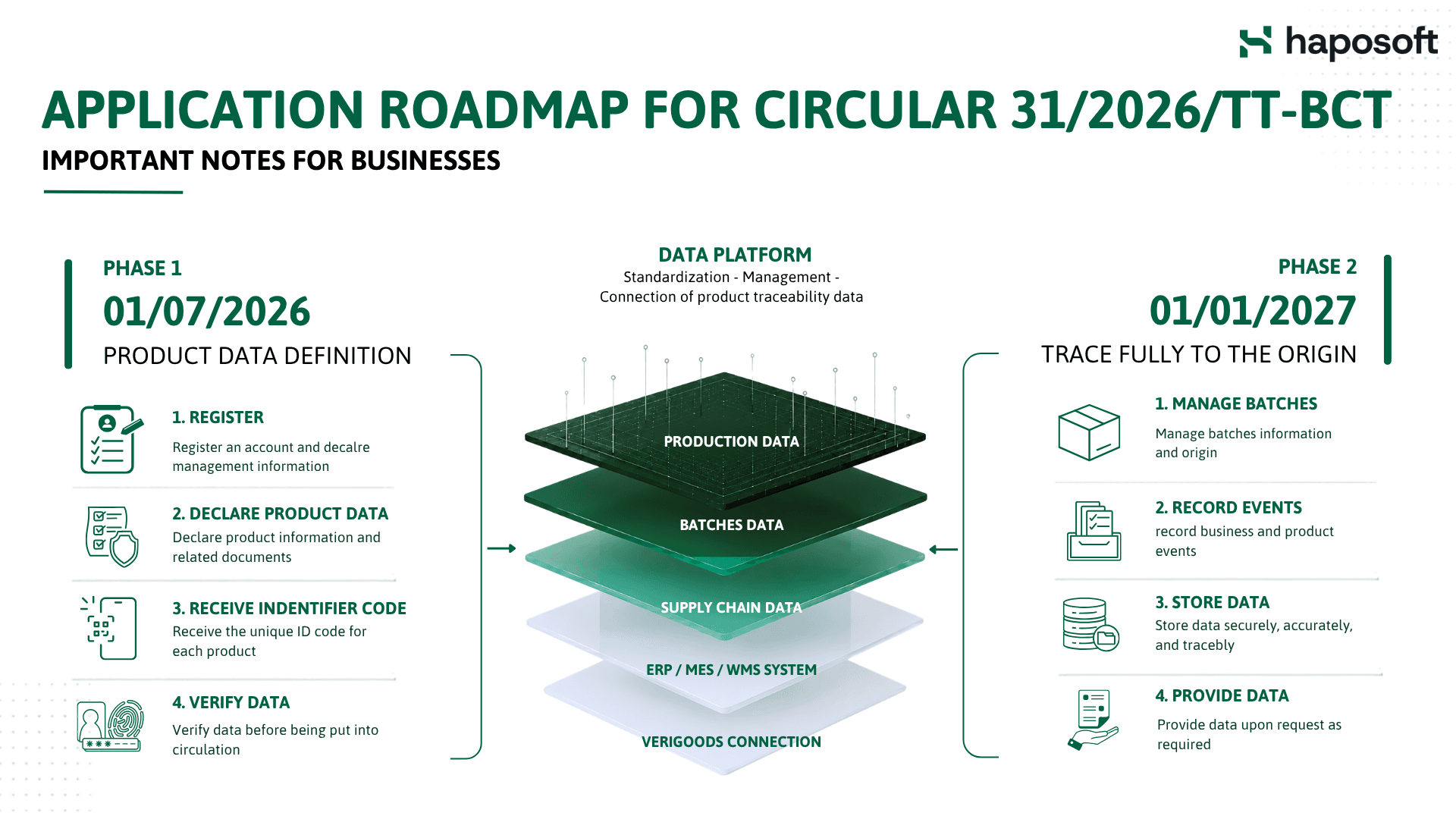
Phase 1: Product identification from July 1, 2026
From July 1st, 2026, businesses subject to these regulations must complete the following steps to identify their products on the system:
- Register a business account;
- Declare legal information;
- Receive product identifier;
- Verify product information on the system.
This is a fundamental step for regulatory agencies to accurately identify the entities and products participating in the traceability system. Businesses should not wait until the last minute to implement this, as reviewing legal documents, standardizing product data, and preparing digital signatures often takes longer than expected.
Phase 2: Full traceability from January 1, 2027
From January 1st, 2027, products subject to regulations must have complete traceability data before being released onto the market. This means that businesses not only need a product identification code, but also:
- Manage production batch/lot data;
- Documenting events in the supply chain;
- Data storage must comply with regulations;
- We are ready to provide data when requested by the regulatory authorities.
In other words, this is the time for businesses to actually operate the traceability system, not just complete the registration process.
What should new businesses keep in mind?
For businesses newly established or commencing production and business operations after January 1, 2027, compliance must be implemented from the moment operations begin. Businesses will not have a transition period like those already operating before that date.
Two key dates to remember.
01/07/2026
→ Begin the product identification phase
→ Register an account, verify it, and receive an identification code.
01/01/2027
→ Begin the full traceability phase
→ Complete the data retrieval process before releasing goods to the market.
What preparations do businesses need to make before January 1, 2027?
The timeframe between now and January 1, 2027, may seem long, but in reality, standardizing data and building a traceability system typically takes months to implement. For businesses highly likely to be impacted by Circular 31, early preparation will significantly reduce the risk of disruption when the regulation becomes mandatory.
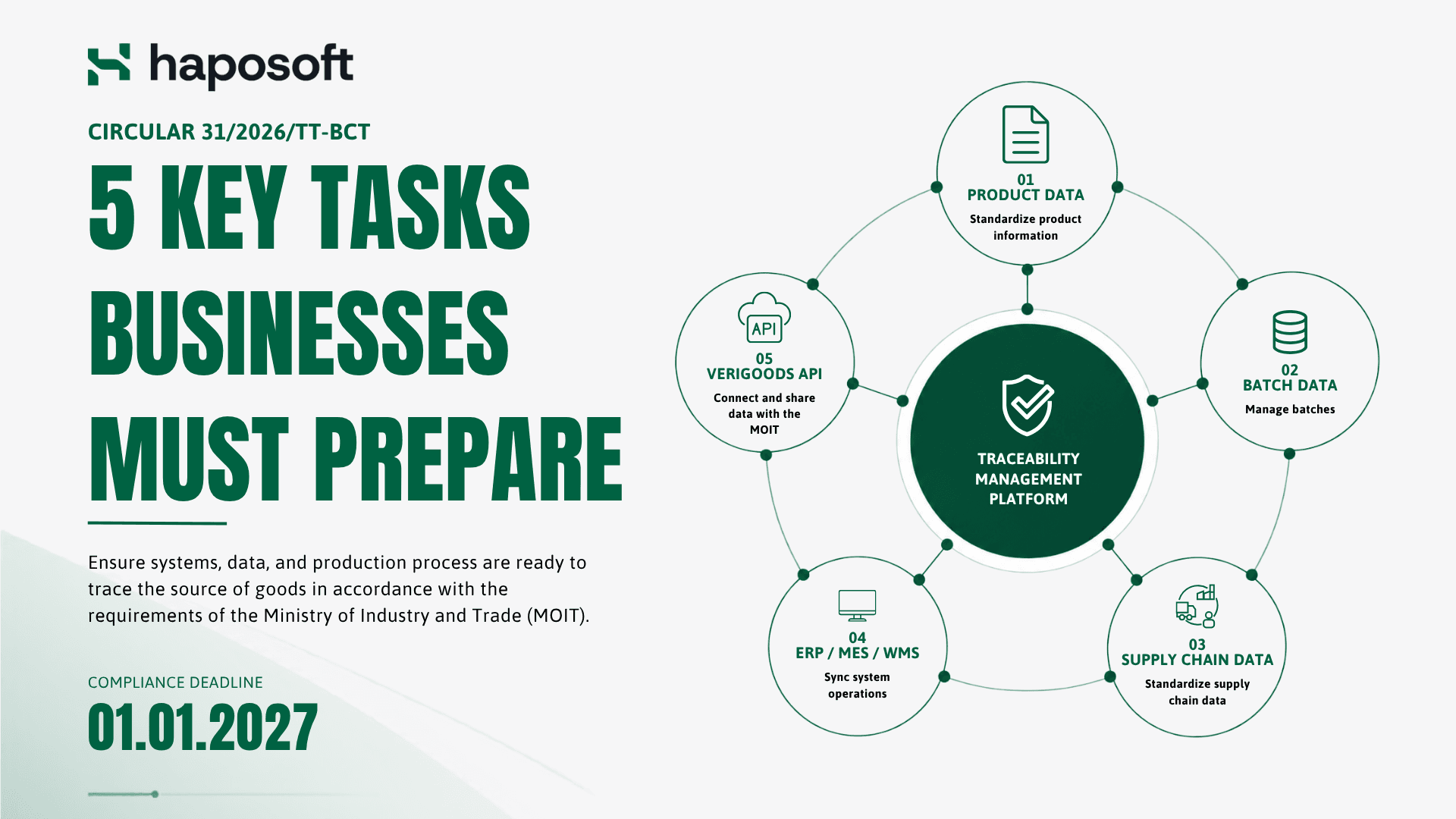
Here are five steps businesses should take starting now.
Step 1: Determine if the product is eligible.
This is the most important step.
Before investing in or implementing a traceability system, businesses need to clearly define:
- Does the product fall under the purview of the Ministry of Industry and Trade?
- Does the product fall under the category of high-risk goods?
- Do the HS code and product declaration documents conform to the current classification method?
For businesses with multiple product lines, it's advisable to create a complete SKU catalog to evaluate each product group separately, rather than drawing general conclusions for the entire business.
Step 2: Standardize product data
According to product identification requirements, businesses need to prepare basic data in advance, such as:
- Product name;
- Product images;
- Brands, trademarks;
- Origin;
- Relevant legal documents;
- Business registration certificate;
- Digital signature.
In reality, many businesses are storing this data in a scattered manner across various departments. This is the right time to standardize and build a unified data source.
Step 3: Standardize production batch and supply chain data.
This is the most challenging part for most businesses. Traceability goes beyond simply attaching a QR code to a product. Businesses need the ability to link data between:
- Input materials;
- Supplier;
- Raw material batch;
- Production batch;
- Quality control;
- Logistics;
- Distribution.
When an incident occurs or an inspection is required, businesses must be able to quickly identify which batches are affected and which stages of the supply chain the product has passed through.
Step 4: Evaluate the current technology system.
Businesses need to review the systems they are currently using, such as:
- ERP;
- WE;
- WMS;
- Quality management system;
- Warehouse management system;
- QR Code management system.
The goal is to identify:
- Where is the data currently located?
- Is it being managed in batches/lots?
- Is it possible to extract data quickly?
- Is it possible to connect to external systems?
Early assessment helps businesses choose the right implementation option instead of having to change the system at the last minute.
Step 5: Prepare to connect to the traceability system.
Circular 31 allows businesses to choose one of two methods:
- Declare directly on the traceability system of the Ministry of Industry and Trade;
- Utilize an internal traceability system and connect the data with the Ministry's system.
For businesses with few products and simple processes, direct declaration may meet their needs. Conversely, businesses with many SKUs, multiple factories, or those operating ERP/MES/WMS systems often need to build an internal retrieval system and synchronize data via API.
Self-assessment checklist for readiness level
- Businesses can conduct a quick self-assessment using the following questions:
- Has it been determined whether the product falls within the scope of application?
- Have the product catalog and SKUs been standardized?
- Have you managed the data in batches?
- Have you prepared digital signatures for product identification?
- Have you determined what data needs to be stored and retrieved?
- Have you assessed the compatibility of your current system with VeriGoods?
If many of the answers are "No," businesses should start the preparation process now instead of waiting until the mandatory deadlines.
Should businesses use VeriGoods or an internal traceability system?
One of the most common questions after reading Circular 31 is:
"Do I just need to register on VeriGoods, or do I need to build an additional traceability system?"
The answer depends on the scale of the data and the complexity of the production and business operations.
What is VeriGoods?
VeriGoods is a product traceability system managed by the Ministry of Industry and Trade.
According to Circular 31, businesses can:
- Declare directly on VeriGoods;
- Alternatively, use an internal traceability system and connect the data to VeriGoods via API.
In other words, VeriGoods is a platform for receiving, verifying, and managing traceability data at the government level.
VeriGoods does not replace the entire internal operational data management system of a business.
When can I declare my goods directly on VeriGoods?
This option is usually suitable for:
- Small businesses;
- Few products;
- There is little variation in production batches;
- There is no ERP or dedicated management system yet.
In this case, businesses can import and manage data directly on the Ministry of Industry and Trade's system without needing to invest in additional technological infrastructure.
When should you build an internal traceability system?
Businesses often need a separate system when:
- There are multiple SKUs;
- There are many factories or production facilities;
- There are many suppliers;
- Managing thousands of production batches each year;
- Are you currently using ERP, MES, or WMS?
- I want to automate the data synchronization process.
In these cases, manually entering data into VeriGoods would quickly become unmanageable and prone to errors.
An internal traceability system allows businesses to collect and manage data right from the stages of production:
- Ingredient;
- Manufacture;
- Testing;
- Logistics;
- Distribution.
The data is then synchronized to VeriGoods as required by the regulatory authority.
What businesses really need to prepare is not the QR code.
A common misconception is that traceability is simply about creating a QR code on packaging. In reality, a QR code is merely a tool for displaying information. The real value lies in the data behind the QR code:
- Source of ingredients;
- Production batch;
- Test results;
- Shipping history;
- Distribution points;
- Supply chain events.
If the underlying data is incomplete or not regularly updated, businesses may still face difficulties when needing to retrieve or provide information to regulatory agencies.
What should businesses evaluate before choosing a solution?
Before deciding to implement, businesses should answer a few questions:
- Where is the data located now?
- Is the process being managed in batches?
- How many SKUs need to be tracked?
- How many factories or production facilities are there?
- Is integration with ERP, MES, or WMS necessary?
- Is it necessary to automatically sync data with VeriGoods?
These questions will help businesses determine whether direct declaration is sufficient or whether a more comprehensive traceability system needs to be developed.
What are the differences between Circular 31 and Circular 11/2026?
Many businesses in the food industry have either explored or are preparing to implement Circular 11/2026/TT-BCT on food traceability.
However, it is important to note that Circular 11 has never been implemented in practice.
Circular 11 was issued on February 27, 2026, and was expected to take effect on April 16, 2026. However, just one day before its effective date, the Ministry of Industry and Trade issued Decision 906/QD-BCT temporarily suspending the validity of this document to further refine the legal framework on traceability.
On June 11, 2026, the Ministry of Industry and Trade issued Circular 31/2026/TT-BCT, which officially came into effect on July 1, 2026.
Therefore, for businesses that are researching or preparing to implement traceability, Circular 31 is a document that should be prioritized for monitoring and application.
Notable changes
|
Content |
TT11/2026 |
TT31/2026 |
|
Scope of application |
Food |
High-risk products and goods fall under the management purview of the Ministry of Industry and Trade. |
|
Status |
It has been temporarily suspended. |
Effective from July 1, 2026 |
|
Initial phase |
Connect the system |
Product identification |
|
Key deployment milestones |
According to the roadmap of Circular 11 |
Identification from July 1, 2026, full access from January 1, 2027 |
|
Applicable system |
National traceability system |
VeriGoods |
|
Incentive mechanism |
Not specified |
Add a "green checkmark" mechanism. |
Do businesses that have already prepared according to Circular 11 need to start over?
Not necessarily.
In fact, much of the data and processes that businesses have prepared for Circular 11 are still valid.
For example:
- Product catalog;
- Batch data;
- Ingredient information;
- Retrieval process;
- QR Code system;
- ERP or MES infrastructure.
However, businesses need to review their practices to ensure compliance with the new requirements of Circular 31, especially:
- Product identification;
- Standardize data according to current requirements;
- Ability to connect with VeriGoods;
- The process of storing and providing data upon request.
What businesses should do now.
If your business has previously been monitoring Circular 11, now is the right time to:
- Update the implementation plan according to Circular 31;
- Review the range of products that may be subject to these regulations;
- Assess the current level of data and system availability;
- Prepare for the milestones of July 1, 2026 and January 1, 2027.
Instead of starting from scratch, businesses should leverage what they have prepared for Circular 11 and adapt it to the requirements of Circular 31.
How can Haposoft assist businesses in complying with Circular 31?
For many businesses, the biggest challenge when implementing Circular 31 is not creating QR codes or registering accounts on the system.
The real difficulties often appear later:
- Product data is stored in various departments;
- Data is not yet fully managed by batch/lot.
- ERP, MES, and warehouse systems are not yet connected;
- It is difficult to trace the source of an incident or product recall.
- There is no solution yet for connecting with VeriGoods.
These are also issues that many businesses are beginning to review as they prepare for the implementation milestones of Circular 31.
Assessing readiness levels ahead of Circular 31
The first step is not to implement the software, but to identify the gap between the current state of the business and the requirements of Circular 31.
Haposoft supports businesses:
- Review existing data;
- Evaluating the traceability process;
- Identify the gaps that need filling;
- Propose an implementation roadmap that is appropriate for the size of the enterprise.
Building a traceability system.
For businesses with many SKUs or complex supply chains, managing data using spreadsheets or manual data entry is often no longer suitable.
Haposoft supports the development of traceability systems that help link data from:
- Input materials;
- Manufacture;
- Quality control;
- Logistics;
- Distribution.
This allows businesses to quickly access the history of each product batch when needed.
.png&w=1920&q=75)
Integration with ERP, MES, and WMS
Many businesses already have operational systems in place, but their data is fragmented.
Haposoft supports data integration from existing systems in order to:
- Reduce manual data entry;
- Minimize data errors;
- Automate the retrieval process;
- Enhance tracing and reporting capabilities.
Connect with VeriGoods
Circular 31 allows businesses to use an internal traceability system and connect it with the Ministry of Industry and Trade's system. Haposoft supports the development of data flows and API integration to synchronize information between the business system and VeriGoods, helping to reduce manual workload during operation.
Prepare early to reduce pressure when the regulations take effect.
For businesses likely to be impacted by Circular 31, early preparation not only helps meet compliance requirements but also lays the foundation for more effective quality management, product traceability, and incident handling in the future. If your business is assessing its ability to comply with Circular 31 or needs to develop a suitable implementation roadmap, the Haposoft team can assist in evaluating the current situation and advising on implementation options tailored to your specific operating model.
Conclusion
Circular 31/2026/TT-BCT transforms traceability from an encouraged activity into a mandatory requirement for certain high-risk product groups under the management of the Ministry of Industry and Trade.
For businesses in the beverage, dairy, and processed food sectors, this is an opportune time to review data, processes, and systems in preparation for rollout milestones from 2026–2027.
👉 Contact Haposoft for advice on implementation roadmap and integration with VeriGoods.