Microsoft has Copilot. Salesforce has Einstein AI. Adobe has Firefly. Almost every software company now has an AI feature to showcase. Yet products built with AI are starting to split into two very different categories. Some use AI to improve existing workflows, while others redesign the workflow around AI itself. This distinction is often described as AI native vs AI augmented.
At a glance, the difference may seem technical. In reality, it affects product strategy, user experience, and long-term competitive advantage. Understanding where a product sits on this spectrum can help businesses make better decisions about AI adoption and investment.
AI Native: When AI Becomes Part of the Workflow
While AI-augmentedAI Augmented products use AI to improve existing workflows, AI Native products are designed around AI from the start. AI is not added later as an enhancement layer. Instead, it becomes a core part of how the product delivers value and how users interact with it.
Perplexity is a useful example. Traditional search engines provide a list of links and leave users to research the answers themselves. Perplexity takes a different approach. Users ask a question, and the system gathers information, synthesizes findings, and delivers a direct response. The value is no longer the search results page. The value comes from AI completing part of the research process on the user's behalf.
The same shift can be seen in industry-specific AI products. Legal professionals using traditional software still spend significant time searching documents, reviewing precedents, and preparing drafts. Platforms such as Harvey integrate AI directly into these workflows, helping lawyers analyze information and generate legal content in a way that would be difficult to achieve through conventional software alone.
Software development offers another useful example. Tools like GitHub Copilot help developers write code faster, making them a clear example of AI-augmentedAI Augmented software. Cursor takes the concept further. Developers can describe an objective, ask questions about a codebase, and delegate larger tasks to AI. The workflow increasingly becomes a collaboration between the developer and the AI rather than a process driven entirely by manual input.
The easiest way to identify an AI Native product is to ask the same question we used earlier: what happens if the AI disappears? In many cases, the product loses a significant part of its value proposition. Remove AI from Perplexity, and it becomes another search interface. Remove AI from Midjourney, and the product effectively stops functioning. AI is not supporting the experience—it is the experience.
Common characteristics of AI-native products:
- AI plays a central role in delivering value.
- Workflows are designed around AI capabilities from the beginning.
- Users focus more on outcomes than on individual tasks.
- The product becomes difficult to separate from the AI powering it.
A simple way to think about the difference is this: AI-augmentedAI Augmented products help people work faster, while AI-native products change how the work gets done in the first place.
AI Augmented: When AI Is a Feature, Not the Whole Product
AI Augmented refers to adding AI capabilities into existing software, workflows, or business processes. Most AI products available today are AI Augmented. Instead of rebuilding software from scratch, companies add AI capabilities to products that already exist. The goal is simple: improve productivity without forcing users to adopt an entirely new way of working.
Microsoft Copilot is a good example. Word, Excel, and Outlook continue to work the same way they always have. Copilot can draft content, summarize information, or suggest improvements, but users still review the output, make decisions, and produce the final result. AI accelerates the workflow without fundamentally changing it. Many popular products follow the same approach:
GitHub Copilot -> Code suggestions
Grammarly -> Writing assistance
Canva Magic Studio -> Content generation
Salesforce Einstein -> Sales recommendations
This leads to one of the easiest ways to identify an AI Augmented product. If the AI capability disappeared tomorrow, would the product still provide value? For most AI Augmented products, the answer is yes. Users would lose productivity gains and convenience, but the core functionality would remain intact because the product was not built around AI in the first place.
Common characteristics of AI Augmented products:
- Humans remain at the center of decision-making.
- AI assists with specific tasks rather than managing the entire workflow.
- Existing processes and interfaces remain largely unchanged.
- Adoption is typically faster and less disruptive than rebuilding systems around AI.
A useful analogy is adding a turbocharger to an existing car. The vehicle becomes faster and more efficient, but its core design does not change. AI Augmented products follow a similar principle. AI enhances the product, but the product itself remains the primary source of value.
Read more: What Is Augmented AI? A Beginner’s Guide to Human-Centered Intelligence
AI Native vs AI Augmented: Key Differences
At first glance, AI native vs AI augmented products can look surprisingly similar. Both may use the same foundation models, offer conversational interfaces, or advertise AI-powered capabilities. The difference lies in the role AI plays within the product and the workflow it supports.
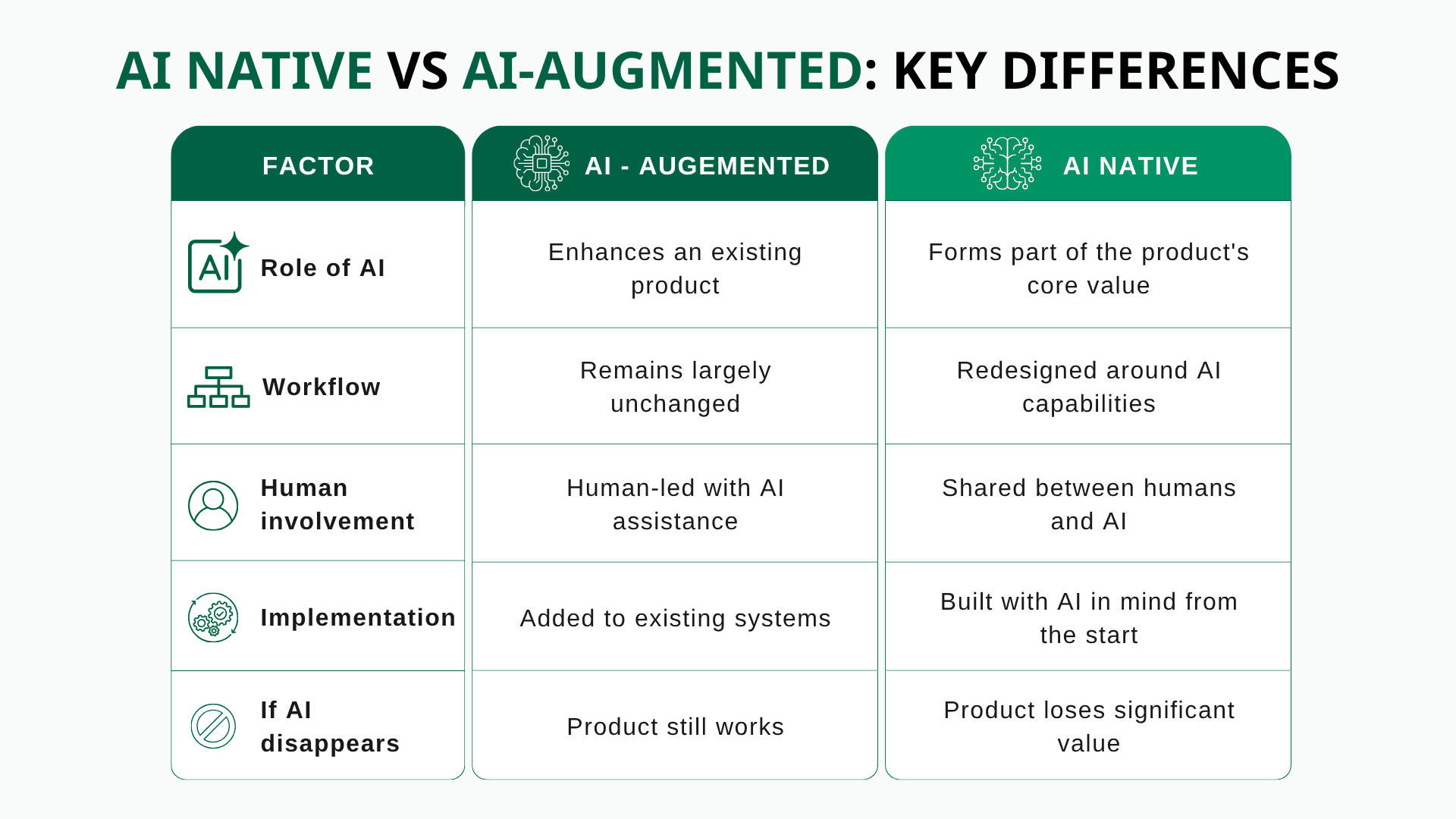
The distinction becomes clearer when viewed through real-world scenarios. Imagine a customer support platform that uses AI to draft responses for support agents. The agent still reviews the answer, edits it if necessary, and sends it to the customer. This is AI Augmented because AI improves a specific task within an existing workflow.
Now imagine a platform where AI receives incoming requests, categorizes them, retrieves information from the knowledge base, responds automatically, and only escalates complex issues to a human agent when needed. In this case, AI is actively participating in the workflow rather than simply assisting with it. This is much closer to an AI Native approach. The same pattern applies across sales, software development, research, and operations. AI Augmented products help teams work more efficiently, while AI Native products aim to redesign how work is performed in the first place.
Read more: 15 Real-World Augmented AI Examples Transforming How We Work
How to Tell Whether a Product Is AI Native or AI Augmented
In practice, the line between AI native vs AI augmented is not always obvious. Many products market themselves as AI-powered, even though AI plays very different roles behind the scenes. Looking at the workflow often provides a clearer answer than looking at the technology stack.
A useful starting point is to ask what happens if the AI component disappears. In an AI Augmented product, the software typically continues to function. Users may lose productivity gains or convenience features, but the core product still delivers value. In an AI Native product, removing AI often breaks a significant part of the experience because AI is directly tied to how the product works.
Another way to evaluate a product is to look at who owns the workflow. AI Augmented products are usually human-led. AI can suggest actions, generate content, or automate small tasks, but people remain responsible for driving the process. AI Native products move further along the spectrum, with AI actively participating in execution rather than simply providing assistance.
The difference becomes easier to spot when comparing similar products.
|
Scenario |
AI Augmented |
AI Native |
|
Customer Support |
AI drafts replies for agents |
AI handles tickets and escalates only when needed |
|
Software Development |
AI suggests code snippets |
AI helps implement features based on developer intent |
|
Search |
AI summarizes search results |
AI delivers direct answers and research synthesis |
|
Sales |
AI recommends next actions |
AI helps execute parts of the sales workflow |
Of course, not every product fits neatly into one category. Many companies are adopting a hybrid approach, combining AI-powered features with workflows that increasingly rely on AI. As models become more capable, the boundary between AI Augmented and AI Native will likely continue to evolve. Rather than treating these categories as fixed labels, it is often more useful to view them as points on a spectrum. The key question is not whether a product uses AI, but how deeply AI is embedded in the way value is delivered.
Why More Companies Are Exploring AI Native Products
The growing interest in AI Native products is not simply the result of better AI models. It reflects broader changes in software development, user expectations, and the way businesses think about automation. Three factors, in particular, are driving this shift.
1. Legacy Software Is Becoming a Constraint
Many established software platforms were designed long before generative AI became practical. As a result, companies often need to fit AI into workflows, interfaces, and architectures that were never built for it.
This approach can work, but it also creates limitations. Technical debt slows down experimentation, legacy interfaces make it difficult to introduce new user experiences, and existing workflows can restrict how much value AI is able to deliver. In many cases, adding AI improves the product, but it does not fundamentally change what the product can do.
2. Users Increasingly Expect Outcomes, Not Tools
Traditional software is designed around tasks. Users click through menus, complete forms, and manually move work from one step to another.
AI is gradually changing that expectation.
Consider the difference between asking AI to help write an email and asking AI to manage a customer follow-up process. The first request improves a task. The second focuses on the outcome. As users become more comfortable working with AI, many are beginning to expect software to help complete larger portions of the workflow rather than simply assisting with individual actions.
3. Agentic AI Is Expanding What Software Can Do
The rise of agentic AI is another factor behind growing interest in AI Native products. Modern AI systems are increasingly capable of handling multi-step tasks, reasoning across different sources of information, and coordinating actions across multiple tools.
Instead of generating a single response, AI can now participate in broader workflows such as research, customer support, software development, and operations. This shift makes it easier for companies to design products where AI becomes an active participant in execution rather than a feature that supports individual tasks.
Together, these changes are encouraging businesses to rethink how products are built. The conversation is gradually moving beyond where AI can be added and toward where AI should be embedded as part of the workflow itself.
AI Native vs AI Augmented for Businesses: Which Approach Should You Choose?
There is no universal answer to the AI Native vs AI Augmented debate. The right approach depends on your business goals, product maturity, available resources, and the role AI is expected to play within the user experience. While AI Native attracts much of the attention today, AI Augmented remains the most practical choice for many organizations.
AI Augmented is often the better choice when:
- You need quick, measurable improvements without rebuilding existing systems.
- Your business relies on complex legacy infrastructure.
- AI is intended to support users rather than become the core product experience.
- Lower implementation risk and faster time-to-market are priorities.
For example, an enterprise CRM platform with thousands of existing customers may gain significant value from AI-powered lead scoring, automated summaries, or email generation. These features can improve productivity without forcing customers to adopt entirely new workflows. In this scenario, an AI-augmentedAI Augmented approach often delivers a stronger return on investment than rebuilding the product around AI.
AI Native is often the better choice when:
- You are building a new product or launching a new business.
- AI is central to the value you provide customers.
- Existing workflows are inefficient and can be redesigned around AI.
- Long-term differentiation is more important than short-term optimization.
This is why many AI-first startups choose a Native approach from day one. Rather than adding AI to an existing product, they design the entire experience around AI capabilities. Products like Perplexity, Cursor, and Harvey are examples of companies that use AI not just as an enhancement, but as a fundamental part of how value is delivered.
In reality, many organizations will find themselves somewhere between these two approaches. A company may begin by introducing AI-powered features into an existing product, then gradually automate larger portions of the workflow as user trust and AI capabilities improve. What starts as AI Augmented can evolve toward a more AI Native model over time.
The goal should not be to force a product into one category or the other. Instead, businesses should focus on identifying where AI can create the most meaningful value for users. In some cases that means improving an existing workflow. In others, it means rethinking the workflow altogether.
Conclusion
The choice between AI native vs AI augmented isn’t about which is "better"—it’s about your strategic horizon.
- AI Augmented delivers Quick Wins: boosting productivity and immediate ROI on existing infrastructure.
- AI Native builds Moats: redefining user experiences and creating entirely new operating models.
The ultimate question for product leaders is no longer "Which AI feature should we build?", but rather: Is AI merely supporting your workflow, or has it BECOME the workflow?
👇 Need a Tailored AI Integration Strategy?
Bolting AI onto legacy systems or building an AI Native platform from scratch requires rigorous evaluation of data infrastructure and unit economics. Our team of experts is ready to help you design a custom AI roadmap in a 1:1 strategy session.