Global applications rarely fail because of code. They fail because latency grows with distance and traffic spikes overload centralized systems. When users are spread across regions, every millisecond of round-trip time adds up. At the same time, unpredictable traffic can push origin servers beyond their limits.
AWS CloudFront helps address both problems, but performance depends heavily on how caching and origin design are configured. A proper CloudFront caching strategy is not optional — it determines whether your system scales smoothly or struggles under load.
The Global Latency Problem and How CloudFront Solves It
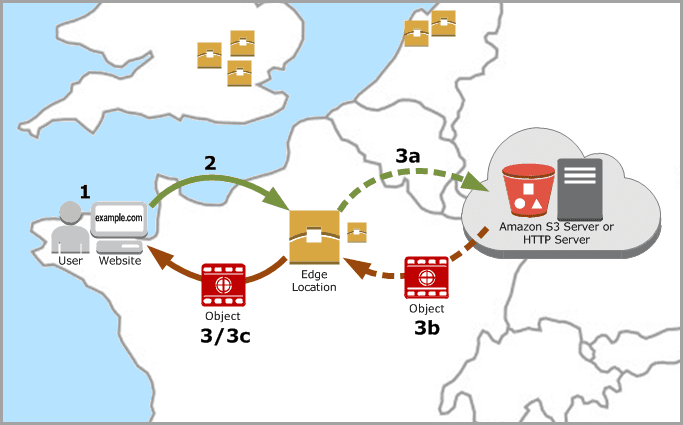
Request/response flow through CloudFront (Edge → Origin on cache miss).
Why global users experience higher latency
Latency increases as distance increases. A request from Europe to an origin hosted in Asia must travel across multiple networks before it returns a response. Even if the backend is well optimized, physical distance and network hops add unavoidable delay. For global applications, this means performance varies by region, and users far from the origin consistently experience slower load times. Over time, this affects both user experience and conversion.
At the same time, traffic spikes amplify the problem. When thousands of users request the same content simultaneously, every cache miss results in another request to the origin. If caching is not properly configured, large volumes of traffic bypass the edge layer entirely. This leads to CPU spikes, longer response times, and potential service degradation. Scaling the origin alone cannot fully solve this structural bottleneck.
How CloudFront reduces latency and origin pressure
CloudFront introduces a distributed caching layer between users and the origin. Each request is routed to the nearest edge location, where content can be served directly if it is already cached. This significantly reduces round-trip time and improves consistency across regions. If the content is not available at that edge, the request moves to a Regional Edge Cache, which stores objects longer and reduces repeated origin fetches across multiple locations.
Only when both cache layers miss does CloudFront contact the origin server. This layered model shifts the majority of traffic away from the backend and closer to the user. As a result, latency decreases and the origin is protected from unnecessary load. However, the effectiveness of this system depends entirely on how caching is configured, which is where strategy becomes critical.
CloudFront Cache Configuration Best Practices
CloudFront performance depends heavily on cache configuration. TTL settings and cache key structure determine whether requests are served at the edge or forwarded to the origin. When configured correctly, caching reduces latency and protects backend systems. When misconfigured, most requests bypass the cache and hit the origin unnecessarily.
Cache Policy
Cache Policy controls two core elements:
- TTL (Minimum / Default / Maximum)
Determines how long objects remain in cache before revalidation. - Cache key composition
Defines which request components are used to differentiate cached objects, including:
- Query strings
- Headers
- Cookies
Every additional element included in the cache key increases the number of cache variations. More variations mean lower hit ratio and more origin fetches.
Best Practices to Increase Hit Ratio
To improve cache efficiency, configuration must be intentional and minimal.
- Reduce cache key dimensions
Only forward query strings, headers, or cookies that actually affect the response. Unnecessary parameters create cache fragmentation. - Static assets: long TTL + versioning
Use long TTL for files such as app.abc123.js. Versioning ensures updated content generates a new filename, allowing aggressive caching without serving stale data. - APIs: shorter TTL + selective caching
API responses should use shorter TTL values but can still be cached based on parameters that truly influence the output. Avoid disabling caching completely unless required.
Anti-Patterns
Some configurations significantly reduce cache effectiveness:
- Forwarding all cookies and headers for every path
This expands the cache key dramatically and lowers hit ratio. - Setting TTL too short for static content
Static files expire too quickly, forcing repeated origin requests and increasing backend load without meaningful benefit.
Cache configuration should vary by content type. Applying a uniform policy across all paths often leads to unnecessary origin pressure.
Designing a Multi-Origin Architecture
Caching alone is not enough if all traffic is routed to a single backend. Different types of content have different performance patterns, scaling requirements, and caching behavior. CloudFront allows multiple origins within one distribution and routes traffic based on path-based cache behaviors. This makes it possible to separate workloads instead of forcing everything through one origin.
With path patterns, requests can be mapped clearly:
- /static/* → Amazon S3
- /api/* → Application Load Balancer or API Gateway
- /media/* → Dedicated media origin
Each path is routed to a specific backend optimized for that workload.
This separation improves both performance and operational control. Static content can use aggressive caching and long TTL values without affecting API behavior. API traffic can use shorter TTL settings and stricter cache policies. Media delivery can be optimized for throughput and file size rather than request frequency.
The objective of a multi-origin design is workload isolation. By separating static assets, APIs, and media into different origins, backend systems scale independently and avoid unnecessary coupling. Combined with proper cache configuration, this architecture reduces origin pressure and allows each content type to follow its own optimization strategy.
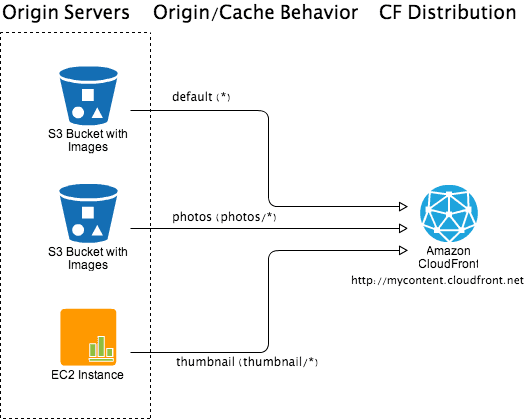
Multi-origin and cache behaviors: mapping path patterns to corresponding origins.
When to Use Origin Shield and Lambda@Edge
Even with proper cache configuration and multi-origin design, multi-region traffic can still create pressure on the origin. This usually happens when the same object is requested simultaneously from multiple edge locations. If each region experiences a cache miss at the same time, the origin receives multiple identical requests. This phenomenon is often called miss amplification.
Origin Shield: Centralizing Cache Misses
Origin Shield adds an additional centralized caching layer between Regional Edge Caches and the origin. Instead of multiple regions fetching the same object independently, requests are consolidated through a single shield region.
Key behavior:
- Multiple edge or regional caches miss the same object
- Origin Shield intercepts and consolidates those misses
- The origin receives fewer duplicate fetches
When enabling Origin Shield, the recommended practice is to select the region closest to the origin. This minimizes latency between the shield layer and the backend.
Origin Shield is most effective when:
- Users are globally distributed
- Content is cacheable
- Traffic spikes occur simultaneously across regions
In these scenarios, it significantly reduces origin load and improves stability.
Lambda@Edge: Executing Lightweight Logic at the Edge
While Origin Shield focuses on reducing backend pressure, Lambda@Edge focuses on moving simple decision logic closer to users. Instead of sending every request to the origin for routing or modification, lightweight processing can occur at edge locations.
Lambda@Edge operates in four phases:
- Viewer Request: rewrite URL, perform lightweight authentication, apply geo-based routing
- Origin Request: modify headers or dynamically select origin before forwarding
- Origin Response: normalize headers or set cookies after receiving origin response
- Viewer Response: add security headers or adjust caching headers before returning to user
The key advantage is reducing unnecessary round-trips to the origin for simple logic. Decisions such as routing, header injection, or query normalization can be handled closer to the user, improving response time and scalability.
Practical Use Cases
Common implementations include:
- Geo-based routing (e.g., EU users to EU origin, APAC users to APAC origin)
- URL rewrite to improve cacheability by normalizing query strings
- Lightweight A/B testing during viewer request phase
- Injecting security headers during viewer response phase
Operational Considerations
Lambda@Edge should remain lightweight. Heavy computation or complex business logic should not run at the edge. Edge execution is best suited for simple, fast operations that reduce origin dependency. Logging and monitoring also require attention. Since execution happens at edge regions, observability must account for distributed logging and metrics collection.
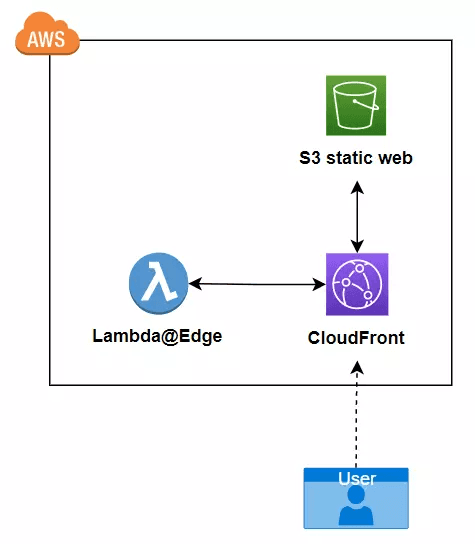
Example architecture using Lambda@Edge integrated with CloudFront.
Deployment Checklist for a High-Performance CloudFront Setup
A well-designed CloudFront architecture should be measurable and repeatable. Before going live, the following checklist helps ensure the system is optimized for both latency and scalability.
- Define cache strategy by path
Static assets should use long TTL with versioning. APIs should use shorter TTL with selective cache key configuration. - Minimize cache key dimensions
Only forward query strings, headers, and cookies that directly affect the response. Avoid forwarding everything by default. - Separate workloads using multi-origin
Route /static/*, /api/*, and /media/* to appropriate origins. This prevents backend coupling and allows independent scaling. - Enable Origin Shield when serving multi-region traffic
Especially useful when traffic spikes occur across regions and content is cacheable. - Use Lambda@Edge for lightweight logic only
Handle URL rewrites, routing, and header adjustments at the edge. Keep business logic in backend services. - Monitor cache hit ratio and origin metrics
Track hit ratio, origin latency, and 5xx error rates. These metrics indicate whether the caching strategy is effective.
Conclusion
CloudFront improves global performance only when caching is configured deliberately. TTL, cache key design, multi-origin separation, Origin Shield, and Lambda@Edge are not independent features. They work together to reduce origin dependency and keep latency predictable across regions.
In practice, most performance issues are caused by cache misconfiguration rather than infrastructure limits. When cache hit ratio increases, backend pressure drops immediately. When origin load decreases, scaling becomes simpler and more cost-efficient.
Haposoft works with engineering teams to review and optimize AWS architectures, including CloudFront cache strategy, origin design, and edge logic implementation. The goal is straightforward: stable performance under real traffic, without unnecessary backend expansion.